
Supplement ecommerce often looks steady from a distance. Regular subscribers reorder every month, loyal customers top up when they run low, and new buyers arrive through paid search, social ads, and marketplace traffic, all contributing to visible sales fluctuations.
Then the calendar shifts, and the pattern changes fast.
Seasonal demand can turn a manageable order flow into a sharp spike in a matter of days. That matters even more in supplements because the customer base is already large and active. The CDC reported that, during August 2021 to August 2023, 60.2% of US adults aged 20 and over used a dietary supplement in the past 30 days, with 38.7% taking two or more. A market with that level of regular use does not need much prompting for order volumes to rise quickly when health goals, gifting periods, or promotional events hit.
For a growing ecommerce business, the challenge is rarely demand alone. The real test is whether fulfilment can keep up without missed dispatch targets, stock errors, or strained customer service. That is where outsourced logistics support, including a third-party logistics provider, can make a measurable difference.
Seasonal demand patterns in supplement ecommerce
Supplement sales are shaped by habit, but they are also shaped by timing. Customers buy with intention, and those intentions, influenced by customer behaviour, change across the year.
January tends to bring a surge in wellness goals. Spring and early summer often lift demand for fitness, performance, and weight-management products. Autumn and winter usually push immunity, vitamins, and general health support higher. Then there are retail-driven spikes, including Black Friday, Christmas, and January sales, when shoppers buy for themselves and for others.
Academic research has also pointed to the need to account for seasonal trends in supplement use, not just long-term market growth. That means a brand cannot rely only on annual sales averages. Monthly and weekly swings matter because warehouse pressure builds in short windows, not in smooth lines.
Common seasonal triggers include:
- New Year health resets
- Midwinter immunity demand
- Summer fitness campaigns
- Major sporting events
- Black Friday promotions
- Christmas gifting
- Subscription renewal clusters
- Limited-time product launches
A wider ecommerce backdrop adds to this. In Great Britain, the Office for National Statistics reported that online sales values in August 2026 were 8.9% higher than a year earlier. When more retail activity is already moving online, seasonal supplement demand can hit harder and spread faster across direct-to-consumer channels.
How seasonal demand changes order volume
The most obvious effect is a jump in order count, yet the real operational impact goes beyond that single number. Seasonal demand changes basket mix, picking complexity, packaging use, returns activity, and customer expectations all at once.
A promotion may increase average order value because shoppers add bundles, multibuys, or complementary products. A wellness campaign may bring first-time buyers who need faster answers from customer support. A holiday event may compress a month of orders into one weekend. Each pattern creates a different workload for the business behind the website.
Providers including 3PLWOW report that supplement brands selling direct to consumers can see order volumes double or triple around New Year, major sporting events, or midwinter health drives. That scale of uplift is exciting from a revenue point of view, but it can expose every weak point in the operation if the business is still fulfilling from a small in-house team.
| Peak period | Common demand driver | Typical order effect | Main fulfilment pressure |
|---|---|---|---|
| January | Wellness goals, reset messaging, subscriptions | Sudden rise in daily orders and repeat purchases | Picking speed, stock allocation, dispatch cut-off management |
| Spring to summer | Fitness and body composition campaigns | Higher bundle sales and promotional packs | More complex pick and pack, packaging consumption |
| Autumn to winter | Immunity and general health focus | Higher reorder frequency from existing customers | Replenishment planning, inbound stock handling |
| Black Friday and Christmas | Discounts, gifting, retailer-wide online traffic | Large order spike over a very short period | Labour capacity, same-day processing, carrier coordination |
| January sales and post-holiday period | Follow-up promotions and returns | Orders remain high while returns begin rising | Admin workload, returns processing, customer queries |
That table shows why seasonal demand is not just a sales issue. It is a warehouse, systems, and service issue as well.
Why growing ecommerce brands feel fulfilment pressure first
Large retailers usually have deeper staffing pools, wider storage footprints, and more mature dispatch systems. Growing brands often have strong products and smart marketing, but far less room for error.
A supplement business that comfortably handles 150 orders a day may struggle badly at 400, even if stock is available. The same shelving layout, the same number of packing benches, and the same admin routines can become bottlenecks overnight. Orders still need to be checked, labels still need to be printed, and tracking messages still need to be sent. None of that disappears because demand is welcome.
There is also the issue of timing. Peak supplement demand often arrives in bursts. Black Friday campaigns, payday promotions, influencer mentions, and email pushes can all land within a narrow window. That creates backlog risk. If the warehouse falls one day behind, the next day’s orders pile on top. Service levels can slip before the brand has time to react.
The pressure usually appears in several places at once:
- Inventory accuracy: Fast-selling lines run out sooner than forecast, while slow lines take up valuable space
- Pick and pack speed: More orders means more touches, more packaging, and more chance of human error
- Warehouse space: Pallets, cartons, and promotional kits compete for room during inbound and outbound peaks
- Customer service admin: Queries about dispatch times, stock availability, and delivery tracking rise quickly
- Returns handling: Sale periods and gifting periods often bring a wave of returns just after the order peak
If any one of those areas falls behind, customer experience suffers. If several fall behind together, the brand can lose repeat business at exactly the point it should be building loyalty.
Why supplement fulfilment needs more than storage space
Supplements are not just another ecommerce category. They often include expiry dates, batch tracking requirements, fragile packaging formats, and product combinations that must be picked accurately. A simple delay can also have a bigger customer impact when the buyer is waiting for a daily-use product.
That changes the role of fulfilment. The warehouse is not merely a holding area for stock. It becomes a live part of the customer promise, directly influencing customer behaviour.
A strong operation needs clear stock visibility, disciplined rotation, fast order processing, and reliable admin around returns and exceptions. During seasonal peaks, those basics need to hold up under much higher volume. If they do, a brand can convert demand into repeat custom. If they do not, marketing success turns into operational strain.
How a 3PL can absorb supplement order spikes
Outsourcing to a third-party logistics provider gives a growing brand access to infrastructure that would be expensive and slow to build alone. That includes warehousing, order fulfilment, pick and pack, labour capacity, carrier relationships, and day-to-day admin support.
This matters most when demand becomes unpredictable. 3PLWOW has noted that sales fluctuations during seasonal spikes can come from Christmas campaigns, Black Friday promotions, January sales, and limited-time offers, with heavy demand often followed by a wave of returns. A capable 3PL helps absorb that volatility by adding space, trained labour, proven systems, and established dispatch capability before delays start to build.
For supplement brands, the value is practical rather than theoretical. Orders can be imported from the ecommerce platform, stock can be stored and rotated professionally, promotional bundles can be assembled, and returns can be processed without pulling the in-house team away from trading activity. That frees the brand to focus on product, marketing, and customer acquisition while the fulfilment partner handles the physical workload.
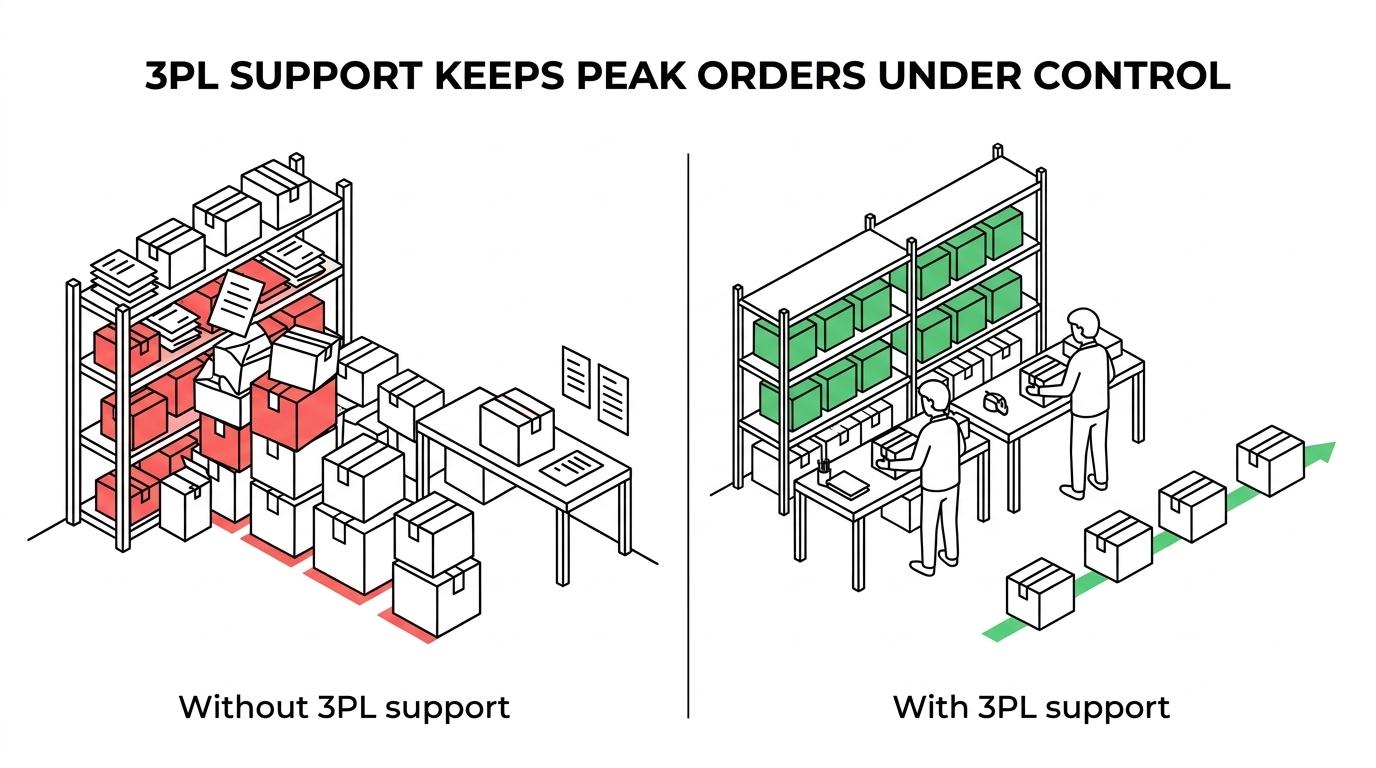
A 3PL relationship can support peak periods in several ways:
- Fast inbound booking and put-away
- Flexible warehouse space
- Trained pick and pack teams
- Carrier rate access
- Returns processing
- Order and stock admin
There is also a planning advantage. Once a brand has several peak periods behind it, a 3PL can help map likely demand patterns against labour, storage, and dispatch capacity. That makes future peaks less reactive and far more controlled.
What 3PLWOW-style support can include for supplement brands
A provider like 3PLWOW is typically brought in to cover more than parcels leaving the building. The strongest support model includes the full chain from goods-in to returns.
That can start with warehousing, where stock is received, checked, stored, and rotated. It extends into pick and pack, where single-unit orders, multibuy orders, bundles, and subscription boxes are assembled accurately. It also includes order fulfilment, meaning the day-to-day processing of customer orders across ecommerce channels with clear dispatch workflows.
Admin support is often underrated, though it is one of the first functions to feel pressure during a peak. Stock queries, returns logging, order exceptions, courier issues, and reporting can consume a surprising amount of time. Handing that workload to a logistics partner helps keep the commercial team focused on sales performance rather than chasing parcels.
How to prepare for seasonal supplement demand before orders rise
Peak performance usually starts weeks before the peak itself. Waiting until orders jump is too late.
Brands that handle seasonality well tend to treat it as an operational event, not just a marketing event. That means forecasting demand, booking stock early, agreeing service levels, and testing how orders will flow through the warehouse when volumes rise.
Useful preparation steps include:
- Forecasting: Build sales scenarios for base demand, likely uplift, and best-case promotional response
- Stock planning: Move best-selling lines and bundle components into the warehouse early enough to avoid inbound congestion
- Order rules: Set cut-off times, shipping options, and exception handling before the campaign starts
- Packaging readiness: Confirm carton sizes, inserts, labels, and branded materials are available in peak quantities
- Returns process: Decide in advance how post-peak returns, exchanges, and customer contact will be handled
A 3PL can support each of these steps. That is one reason outsourced fulfilment is attractive for fast-growing supplement businesses. It gives access not only to labour and space, but also to operational rhythm.
Measuring whether seasonal fulfilment support is working
Peak trading should be assessed with more than revenue figures, taking into account customer behaviour. Strong sales with weak fulfilment can still damage the business if customers receive late, incorrect, or poorly packed orders.
Useful measures include dispatch speed, order accuracy, stock accuracy, returns turnaround time, and customer contact volumes during the peak window. If those figures remain stable while order volume rises, the operation is coping well. If sales climb but service metrics fall sharply, the business may need more warehouse capacity or a stronger logistics setup to better handle sales fluctuations.
Seasonal demand is a sign of market opportunity. In supplements, it often arrives in predictable waves, even when exact order counts vary. Brands that prepare for those waves, and use fulfilment partners with the right systems and capacity, are in a far better position to turn short bursts of demand into lasting growth.