
What Supplement Brands Should Look for in a 3PL
For supplement brands, choosing a 3PL is not simply about finding extra warehouse space or a lower pick fee. In the UK, food supplements are regulated as food, which changes the brief entirely. The right fulfilment partner needs to support food-law controls, traceability, storage discipline and recall readiness as part of day-to-day operations.
That is why a good fit is rarely the cheapest generic eCommerce warehouse. A supplement brand needs a supplement 3PL that can handle distribution of capsules, powders, gummies, sachets and health products with the same care it gives to speed and parcel dispatch.
Why supplement fulfilment in the UK is different from general eCommerce fulfilment
Food supplements sit inside the wider framework of food law. That matters because storage, labelling, traceability and record keeping are not optional extras. They are part of how the product is handled legally and commercially once it enters the supply chain.
In practical terms, that means a supplement brand should expect a 3PL to think like a food logistics operator, not only a parcel fulfilment business. Orders still need to be picked quickly and packed neatly, of course. Yet the stronger question is whether the operation can support batch and lot traceability, expiry-date control and documented movement of goods.
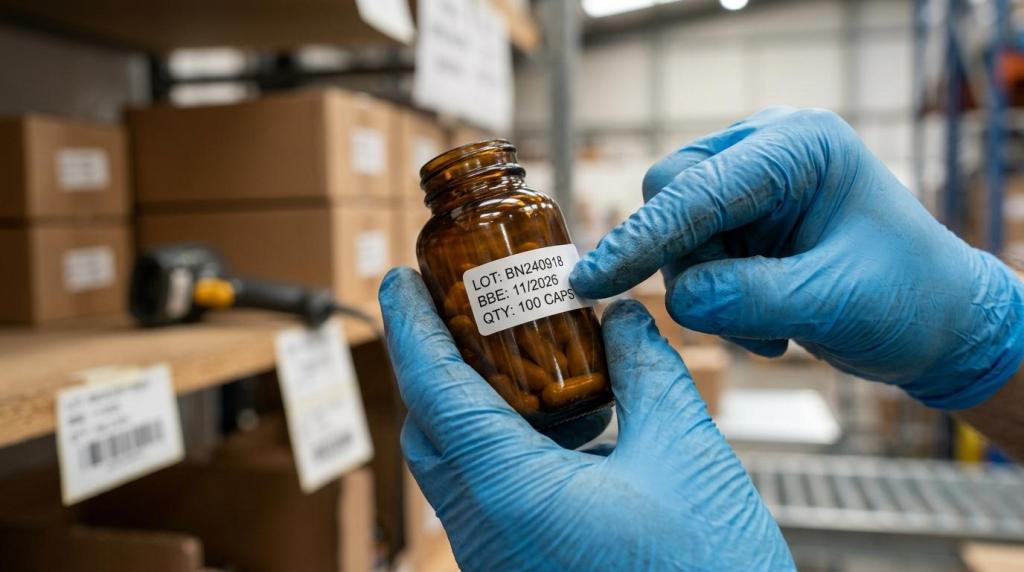
Official UK guidance also makes labelling relevant to warehousing. Food supplements need clear product information, including the product name as a food supplement, business name and address, ingredients, warnings, storage instructions, and a use-by or best-before date where applicable. Food labels must also show a lot number or date marking and any special storage conditions. A 3PL may not create the label copy, but it should have processes that prevent the wrong version being applied, packed or shipped.
The traceability standard is equally important. Food businesses are expected to keep records on a “one step back, one step forward” basis. In plain terms, the business should be able to identify suppliers and business customers, and products should be labelled or identified in a way that supports traceability. A supplement 3PL should therefore be able to show how it records inbound stock, storage location, batch movement and outbound shipment.
Core 3PL capabilities supplement brands should assess
A supplement brand can save time by starting with a simple test: can this provider prove food-grade controls and traceability, or is it mainly selling low fulfilment fees? Price matters, but it should come after operational fit.
The strongest 3PL partners usually stand out in a few clear areas:
- Batch and lot traceability: Each inbound batch should be identifiable and linked to stock locations and outbound orders.
- Expiry-date control: Stock should be managed in a way that protects shelf life and reduces the risk of old product being shipped.
- Recall-ready records: Data should be easy to retrieve quickly if a withdrawal or recall is required.
- Storage discipline: Conditions should match the product format, with stable, clean and monitored space.
- Labelling accuracy: The operation should prevent the wrong SKU, lot or pack format from being dispatched.
- Hygiene routines: Cleaning, handling controls and food-safe working practices should be documented.
This is where many generic 3PL options start to look less convincing. They may be excellent at moving fashion, gifts or accessories, yet weak on food-grade procedures. Supplement brands should ask to see how goods are booked in, how lot numbers are recorded, how expiry dates are managed and what happens when stock is quarantined.
A useful sign of maturity is when the warehouse team can answer these questions clearly and without improvising. If the process is robust, it tends to be explained in a straightforward way.
Warehouse management and stock control features that matter for supplements
Warehouse management and stock control are often treated as background functions. For supplements, effective inventory management and stock control are front-line risk controls.
A good warehouse management setup should give the brand visibility over what is on hand, where it is located, which batch it belongs to and when it expires. That visibility supports forecasting, promotion planning, wholesale replenishment and customer service. It also supports compliance if an issue appears later.
Stock control is where small weaknesses become expensive. A missed expiry date, an unrecorded pallet move or a label mismatch can trigger write-offs, customer complaints and extra admin. For supplement brands that run subscriptions or high-repeat orders, even minor stock errors can quickly affect retention.
The table below shows what to check when assessing a provider.
| Area | What good looks like | Why it matters for supplement brands |
|---|---|---|
| Inbound booking | SKU, batch, lot and expiry captured at goods-in | Protects traceability from the first warehouse touchpoint |
| Stock locations | Clear bin or pallet location control | Reduces mis-picks and improves auditability |
| Expiry management | System-led visibility of shelf life | Helps prevent aged stock shipping late in the cycle |
| Quarantine process | Damaged, returned or suspect stock held separately | Prevents accidental resale |
| Reporting | Regular stock, batch and order reports | Supports planning, QA review and customer service |
| Traceability records | Supplier and customer movement data retained | Supports “one step back, one step forward” expectations |
| Storage conditions | Clean, stable and monitored warehouse environment | Protects product quality and label integrity |
For brands with more than one channel, stock control becomes even more valuable. Direct-to-consumer orders, wholesale cases, Amazon replenishment and promotional kits all place different demands on the same inventory pool. A capable 3PL should be able to manage those flows without losing batch visibility through efficient inventory management.
Some supplement ranges need more than ambient storage. If a product format requires cooler conditions, the provider should be able to match that need. Published information from 3PLWOW refers to storage starting from 2°C upwards, which may be relevant for brands with sensitive products or a wider health-food range.
Pick and pack requirements for supplement brands
Pick and pack is the part of fulfilment customers actually see, and it should reflect the standards behind the warehouse operation.
Accuracy comes first. A vitamin D SKU that looks similar to another strength, or two gummy products with near-identical packaging, can be easy to confuse in a weak system. Scanning, location discipline and trained staff all help reduce that risk. For supplement brands, accuracy is not only a service metric. It is part of product safety and trust.
Packaging quality matters too. Tubs, pouches, cartons and glass bottles all need suitable packing methods. The right 3PL should protect product presentation while keeping parcels commercially sensible. A dented tub or burst pouch may still count as “shipped”, but it does not support repeat purchase.
After those basics, good supplement fulfilment often includes a few extra needs:
- Multi-SKU bundles
- Introductory kits
- Subscription order handling
- Leaflet insertion
- Wholesale case picking
This is where tailoring becomes valuable. Some brands want minimalist direct-to-consumer dispatch. Others need influencer mailers, retail-ready outers or campaign bundles built to a deadline. The best setup is one that can switch between those formats without creating stock confusion.
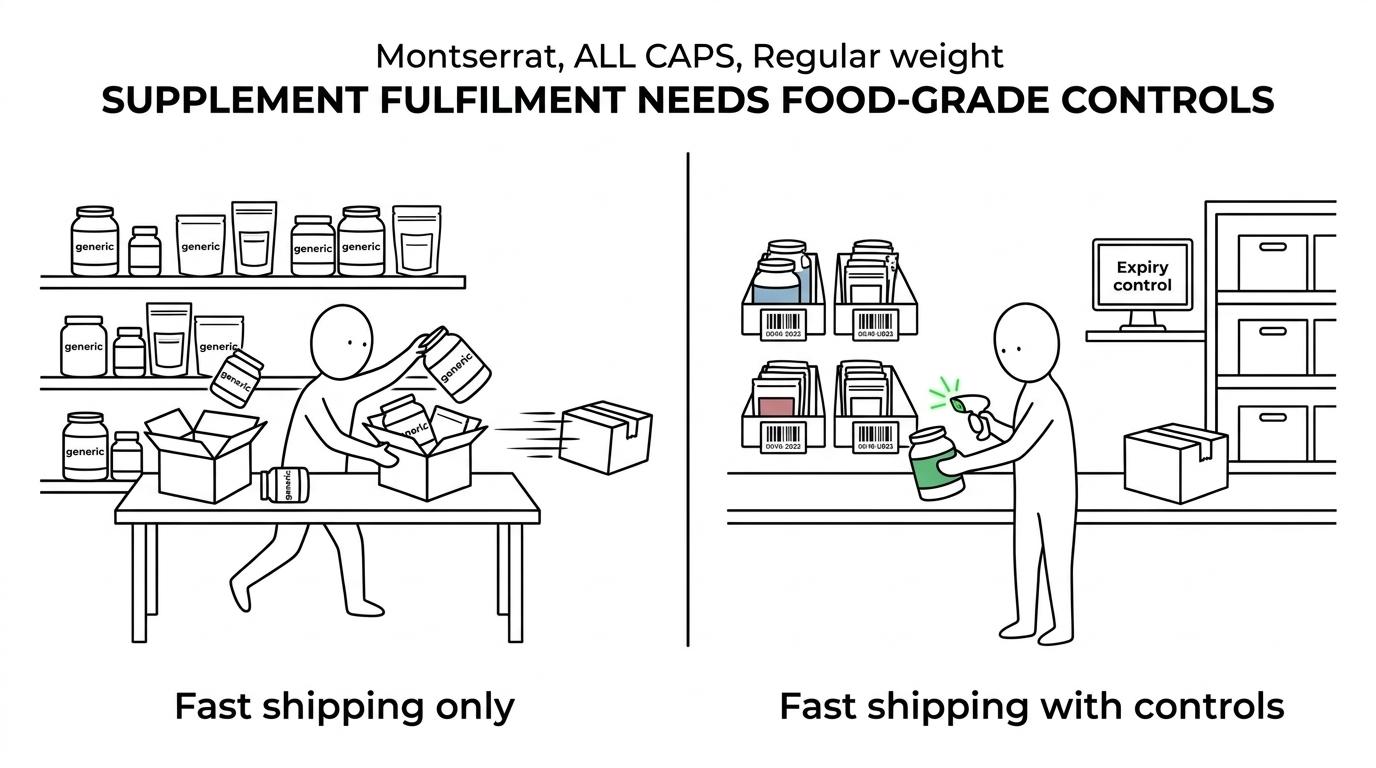
Published material from 3PLWOW states that supplement fulfilment should include batch and lot traceability, expiry-date control and correct labelling. That combination is exactly what brands should want from a pick and pack partner: fast fulfilment with controls that suit a food category.
Shipping services supplement brands should expect from a 3PL
Shipping is often judged by speed alone. For supplements, the better question is whether the shipping setup supports the product, the channel and the customer promise.
A direct-to-consumer brand may need parcel services that balance cost, delivery speed and tracking quality. A wholesale-focused brand may need carton or pallet dispatch with booking-in compliance for retailers. A growing brand may need both at once. A 3PL should be comfortable across these shipping profiles, with service options that can flex as volumes change.
The handover from warehouse to carrier also needs discipline. Correct shipping labels, address validation, parcel tracking and exception handling all make a difference. If an order is delayed, lost or damaged, the fulfilment partner should have a clear process for investigation and replacement support.
There is also a product-care angle. While many supplements sit well in ambient delivery networks, some product types are more sensitive than others. If storage instructions apply, the provider should be able to show how those needs are handled before dispatch and during any special transport arrangement.
A brand should ask direct questions about shipping operations:
- Carrier mix: Are there options for economy, next-day, signed-for and bulk shipment?
- Dispatch cut-offs: How late can orders be processed without accuracy slipping?
- Exception handling: What happens when a parcel is delayed, refused or returned?
- International support: If cross-border shipping is offered, how are labels and customs data managed?
These points sound operational, because they are. Yet they also shape customer perception. Reliable shipping protects reviews, repeat sales and retailer confidence.
How 3PLWOW can tailor services for supplement brands
For supplement brands looking for a more category-aware partner, 3PLWOW positions its service around the specific needs of food supplements rather than generic fulfilment. That distinction matters because the core requirement is not only getting parcels out of the door. It is building fulfilment around traceability, storage discipline and stock control.
In published information, 3PLWOW highlights batch and lot traceability, expiry-date control, correct labelling and stable, clean, monitored warehouse conditions for supplements. Those are the right signals for brands that need a 3PL to support food-grade handling standards.
Its service tailoring can be viewed across four practical areas.
Pick and pack services for supplement orders
A supplement brand may need single-item orders, bundles, sample kits, subscription packs or influencer mailers. Tailored pick and pack means the warehouse process matches the commercial model rather than forcing the brand into a rigid template.
For a fast-growing direct-to-consumer business, that can mean barcode-led accuracy, branded inserts and dependable same-day dispatch cut-offs. For a wholesale or multi-channel brand, it can mean case picking, channel-specific packing instructions and careful handling of retailer orders.
Warehouse management for food-grade fulfilment
Warehouse and inventory management should support visibility and control, not just storage. A tailored service would usually include inbound booking that captures key batch and expiry information, location management that reduces stock errors, and reporting that helps the brand plan replenishment and promotions.
3PLWOW also refers to ambient warehouse standards that are stable, clean and monitored, which is a sensible fit for many supplement lines. Where products require cooler conditions, published material also refers to storage starting from 2°C upwards.
Stock control that supports traceability
Stock control for supplements needs to go beyond quantity counts. A brand should expect batch-linked stock records, expiry-date awareness and a process for quarantined or returned goods.
This is especially useful during growth periods. Published 3PLWOW material points to a case study where monthly order capacity increased from 15,000 to more than 35,000 within 90 days after outsourcing, while order accuracy improved from 96.2% to 99.4%. Even allowing for the fact that every operation is different, those are the kinds of improvements brands look for when fulfilment is redesigned around stronger systems.
Shipping that fits channel and product needs
A tailored shipping service should reflect whether the brand sells direct to consumers, to marketplaces, to retailers, or across all three. The benefit is not only speed. It is choosing the right carrier mix, packing method and service level for each order type.
For supplement brands, that flexibility can reduce cost on routine orders while still protecting service levels during launches, promotions and seasonal spikes.
A strong 3PL relationship gives supplement brands more than outsourced logistics. It creates an operating base that supports compliance, protects product integrity and leaves room for growth. When the warehouse, stock control, pick and pack, and distribution model are built around the realities of supplement fulfilment, the brand is in a much stronger position to scale with confidence.