
How Subscription Fulfillment Differs From Standard E-commerce
A one-off online order and a subscription order may look similar on a dashboard, yet they behave very differently in the context of order management once they reach the warehouse.
That difference matters a great deal for brands selling supplements, collagen powders, capsules, sachets, and bundled wellness products. A standard e-commerce operation is built to receive an order, pick it, pack it, and send it. Subscription fulfilment has to do that too, but on a repeating schedule, often at higher volume peaks, with tighter service expectations and much less room for error.
Research on subscription commerce has treated recurring delivery timing and customer preferences as core parts of the model, not as minor variations on ordinary retail. That is exactly why subscription fulfilment needs its own operating logic.
Subscription fulfilment vs standard e-commerce fulfilment
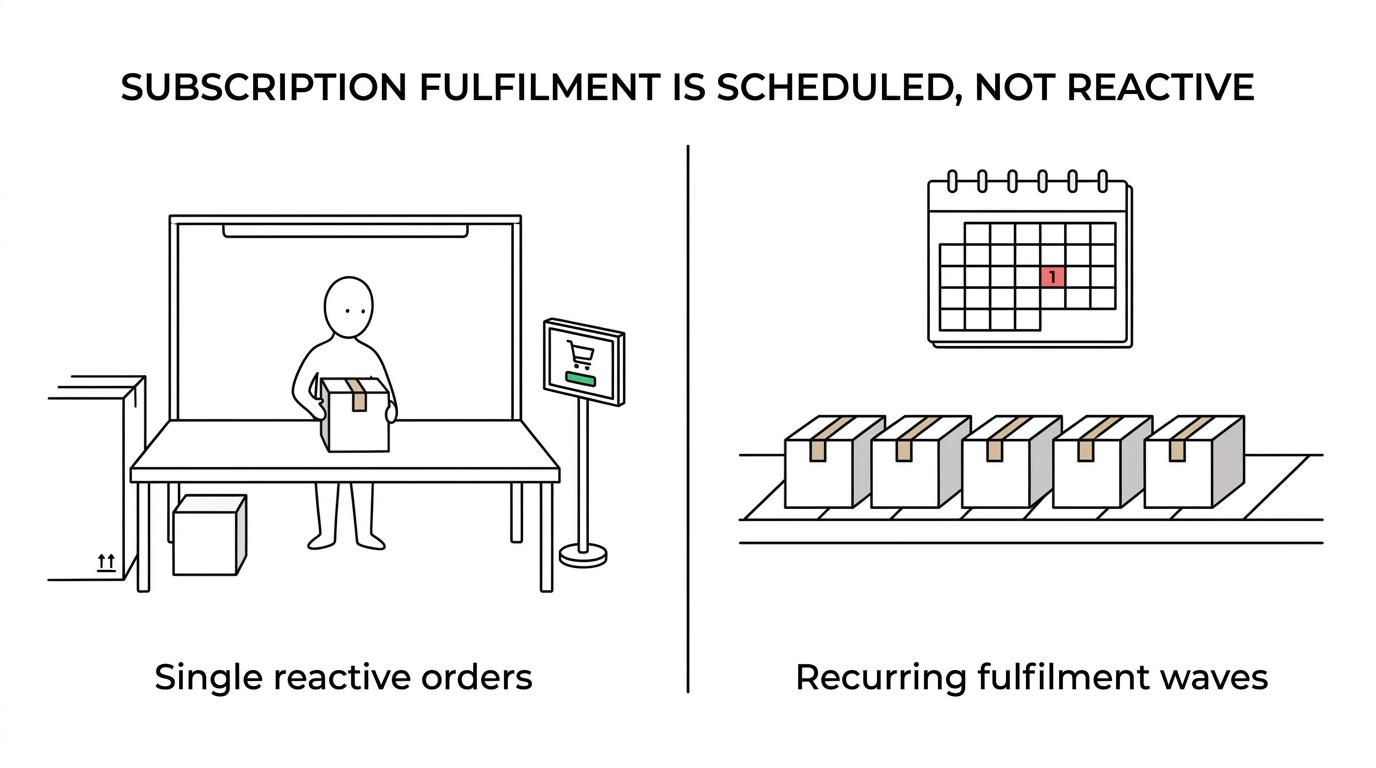
In standard e-commerce, demand is reactive. A customer buys once, the warehouse processes that order, and the relationship may or may not continue. The parcel still needs to arrive quickly and correctly, though the fulfilment event is usually isolated.
Subscription fulfilment is scheduled demand. Orders recur weekly, fortnightly, or monthly, whether the customer actively checks out each time or not. That creates recurring delivery waves rather than a steady stream of unrelated parcels.
The difference sounds simple. Operationally, it is not.
A missed or inaccurate one-off order is a poor customer experience. A missed or inaccurate subscription order can disrupt an entire cycle, create service queries at scale, involve product returns, and damage retention. If a subscriber expects collagen sachets on the first week of every month and the parcel arrives late or incomplete, the issue is not just the parcel. It calls the whole service promise into question.
Why recurring orders change warehouse planning
Subscription brands rarely fulfil against a random pattern. They fulfil against a calendar.
That means warehouse teams need to prepare for concentrated dispatch windows, recurring order waves, and fixed cut-off points. A strong month can bring a rapid increase in subscriber numbers, and that growth can compound quickly. A brand with 2,000 active subscribers that gains 300 new customers in a month does not just add 300 orders. It adds 300 repeat commitments into future cycles as well.
This is where subscription fulfilment starts to separate itself clearly from standard online retail:
- recurring dispatch schedules
- pre-planned volume surges
- repeat billing and repeat shipping cycles
- stronger forecasting discipline
- less tolerance for stock misallocation
In a standard store, demand spikes may happen around promotions, payday, or Christmas. In subscriptions, peaks are often self-created by the brand’s own billing calendar. If most customers renew on the same few dates, the warehouse must be ready for a large batch of orders that all need to leave on time.
That puts more pressure on labour planning, stock positioning, packaging availability, carrier bookings, and system accuracy.
Why supplements and collagen subscriptions are more complex
Supplements and collagen products add another layer of care because they often come with product rules that are stricter than general merchandise.
A fashion brand might substitute presentation tissue or switch outer cartons with little consequence. A collagen brand sending tubs, sticks, capsules, and add-on wellness goods cannot take the same relaxed approach. Batch control, date rotation, and exact SKU selection matter more, especially when customers are using products daily and expect continuity.
Many wellness subscription brands also sell in several formats at once. One customer may receive a single collagen powder tub every month. Another may receive a mixed pack with sachets, shaker, travel samples, and a promotional leaflet. A third may pause for six weeks, then resume with a different flavour and a one-time upsell.
That creates operational complexity in a few distinct areas:
- Expiry management: supplement stock needs careful date rotation so near-dated goods are not sent inappropriately
- Batch accuracy: traceability can matter more in ingestible products than in general consumer items
- Pack variation: customers may switch flavour, format, or plan length between cycles
- Promotional inserts: launches, welcome cards, and cross-sell samples often change by campaign
- Regimen continuity: missing one monthly delivery can interrupt a customer’s routine, making complaints more likely
For collagen and supplement brands, order management and fulfilment are tied closely to trust. Customers are not only buying a parcel. They are buying consistency.
A practical comparison of the two fulfilment models
A side-by-side view makes the distinction clearer.
| Area | Standard e-commerce fulfilment | Subscription fulfilment |
|---|---|---|
| Order trigger | Single checkout event | Recurring billing or scheduled renewal |
| Demand pattern | More variable, often promotion-led | Calendar-driven with repeat order waves |
| Customer expectation | Fast delivery for a single purchase | Reliable delivery every cycle |
| Impact of an error | Affects one order | Can affect retention and future revenue |
| Inventory planning | Based on open demand and campaigns | Based on active subscriber base and forecasted renewals |
| Pack structure | Often one SKU or a simple basket | Often kits, bundles, samples, inserts, or personalisation |
| Operational priority | Speed and cost control | Accuracy, timing, continuity, and scalability |
| Service measure | Delivery speed and order accuracy | OTIF, renewal support, cycle stability, and low exception rates |
OTIF, meaning on-time, in-full delivery, is a useful lens here. In standard e-commerce it is valuable. In subscriptions it becomes central. If the parcel is late, or if one item is missing, it can lead to product returns, and the monthly promise has not been met.
Why rising subscription numbers create a different scaling problem
Rising subscriber numbers mean rising committed order numbers in future periods, not just a temporary burst.
That affects more than parcel volume. It affects goods flow too.
A supplement brand might begin with two hero products and a simple monthly repeat model. Six months later, it may be shipping collagen in multiple flavours, capsules, travel sachets, starter kits, and seasonal add-ons. The number of active goods rises alongside subscriber volume. So does the number of possible pack combinations.
A warehouse operation that was efficient at 500 repeating orders can become fragile at 5,000 if the systems, labour model, and stock controls were designed for ordinary e-commerce.
The warning signs are usually easy to spot:
- increased picking exceptions
- more subscriber service tickets
- stockouts around renewal dates
- missed carrier cut-offs
- manual workarounds in spreadsheets
Kitting and personalisation in subscription fulfilment
Kitting is one of the biggest operational differences between these models.
A standard e-commerce order often involves picking finished goods straight from storage and packing them into a shipping carton. Subscription orders frequently need pre-assembled kits, changing combinations of products, or inserts matched to a specific campaign or customer group.
That could mean a welcome pack for new subscribers, a retention gift for long-term members, or a collagen subscription box with a shaker, guide card, and trial SKU added for one billing cycle only.
This is where accuracy pressure rises sharply. One wrong insert may be harmless. One wrong supplement variant is a more serious issue. When these decisions are repeated across hundreds or thousands of monthly orders, small process weaknesses can multiply fast.
A specialist operation usually treats kitting as a structured workflow rather than an informal packing task. That may include pre-building kits ahead of cycle peaks, allocating components in advance, and using clear stock rules so promotional materials do not run short halfway through a wave.
Why retention depends on fulfilment quality
Subscription businesses live and die by repeat behaviour.
That makes fulfilment part of commercial performance, not just a back-end function. If the warehouse misses a billing cycle dispatch, sends the wrong collagen flavour, or fails to include a promised item due to poor order management, customer support feels the impact immediately. Soon after, cancellation rates can follow.
The commercial link is straightforward. A standard one-off order can disappoint a customer once. A subscription issue can break confidence in the service itself.
That is why subscription brands tend to need tighter operational discipline around:
- Cycle control: orders must release and dispatch in the right wave
- Inventory confidence: stock must be available before recurring demand hits
- Exception handling: pauses, swaps, skips, and renewals need clean processing
- Customer continuity: the experience should feel dependable every month
For wellness products, that dependability often matters even more. Many subscribers are using these goods as part of a routine related to fitness, beauty, or general wellbeing. A delayed replenishment feels disruptive in a way that a delayed impulse purchase may not.
How a 3PL like 3PLWOW supports subscription brands
A third-party logistics provider with subscription experience can remove a large amount of operational strain, especially when order numbers and SKU counts begin to rise together.
A provider such as 3PLWOW is relevant here because subscription fulfilment needs more than storage and despatch; it also needs efficient handling of product returns to maintain customer satisfaction. It needs repeat-cycle processing, dependable cut-off performance, kitting services, and the discipline to manage changing order contents without losing accuracy.
For supplement and collagen brands, that kind of support can cover both scale and precision. Instead of building every process in-house, the brand can use a fulfilment partner already set up for recurring order waves and kit-based dispatch.
That kind of 3PL input is often most valuable in these areas:
- Recurring order processing: handling scheduled order releases in predictable waves
- Kitting services: building subscription packs, welcome boxes, bundles, and promotional sets
- Personalisation support: managing inserts, variable contents, and customer-specific pack rules
- On-time dispatch: protecting cut-offs so monthly delivery promises are met
- Operational flexibility: coping with rising subscriber counts and expanding product ranges
3PLWOW also positions subscription fulfilment around the realities of repeat service expectations. That is an important distinction. Standard fulfilment aims to send parcels efficiently. Subscription fulfilment must support a relationship that is evaluated every month.
When subscription brands outgrow standard fulfilment
Many brands begin with a perfectly sensible in-house setup. It works well when volumes are low, the product range is simple, and the subscriber base is still forming.
Pressure builds when several factors arrive together: more recurring orders, more product variants, more kitting, and less tolerance for delay. At that point, standard e-commerce processes often start to show their limits.
A supplement or collagen brand may have enough demand to justify specialist help if it is dealing with regular monthly waves, growing SKU complexity, and a customer base that expects routine replenishment without mistakes.
The shift is not only about space in the warehouse. It is about process maturity.
Subscription fulfilment asks for planning, accuracy, and repeatability at a higher level than most standard e-commerce flows. Brands that recognise that early are usually in a stronger position to protect customer loyalty while still growing at pace.