
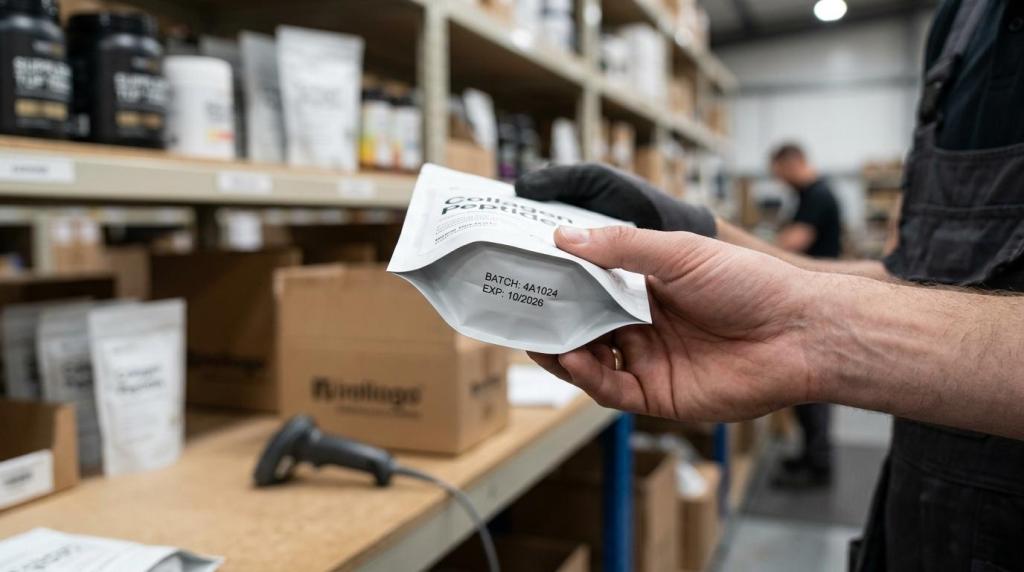
Collagen E-commerce Fulfillment Trends UK
Collagen supplements have moved well beyond niche wellness shelves, particularly with the rise in online shopping. In the UK, they now sit inside a busy e-commerce environment where customers expect fast delivery, accurate orders, and products that arrive in excellent condition with clear date and batch information, reflecting current market trends.
That combination is what makes collagen fulfilment different from ordinary pick-and-pack through an efficient supply chain. A growing brand is not simply sending parcels. It is managing food-supplement compliance, date-sensitive stock, subscription-style repeat orders, and carrier performance at the same time. For many collagen sellers, this is where fulfilment starts to shape growth rather than just support it.
Why UK collagen e-commerce fulfilment needs specialist operations
Collagen products may look simple on the front end. A customer places an order, a pouch or tub is packed, and a parcel goes out to customers. Behind that basic sequence sits a more demanding operational model.
In the UK, collagen supplements are regulated as food rather than medicines. That means fulfilment cannot be treated like generic merchandise handling. Stock rotation, labelling accuracy, storage discipline, and traceability all matter. If a brand sells powders, capsules, sachets, or gummies across omnichannel marketplaces and direct-to-consumer channels, the warehouse has to keep those product lines moving without losing control of dates, batches, or packaging standards.
Speed matters too.
Retail Economics has reported that delivery speed is now widely treated as a baseline expectation rather than a premium extra, and consumer awareness of next-day and same-day services is deeply established. For collagen brands, that creates a tight operating window: remain compliant, stay accurate, and dispatch fast enough to match rising service expectations.
UK food supplement compliance requirements for collagen orders
According to GOV.UK, food supplements in the UK fall under general food law. Businesses selling them must register as a Food Business Operator with the local authority, and labels in Great Britain must include items including a use-by or best-before date, storage instructions, ingredients, and conditions for use.
That matters directly to e-commerce fulfilment. Warehousing is not just a storage function. It is part of the compliance chain. If products are picked from the wrong batch, shipped too close to date, or sent via inadequate shipping methods in damaged packaging with compromised labelling, the problem reaches the customer immediately and can become much more than a customer service issue.
A collagen fulfilment process should be built around a few non-negotiables, with an emphasis on personalisation:
- batch traceability
- date-sensitive stock control
- accurate SKU mapping
- storage condition discipline
- clean packing workflows
- documented handling procedures
The most capable operations treat this as standard warehouse design, not as an afterthought. That often means using first-expiry-first-out logic for date-led stock movement, recording inbound batch data carefully, and linking warehouse activity to order records so a brand can answer questions quickly if a retailer, regulator, or customer needs details.
Consumer delivery expectations for UK collagen e-commerce
Fast delivery is no longer a bonus line on the ecommerce checkout page; it is a critical component of the customer experience and part of the product promise.
Ofcom has reported strong public awareness of next-day and same-day delivery, and its cited research found that half of respondents had used next-day delivery at some point. Retail Economics has also noted that more than half of consumers in North America and Europe expected a standard online order to arrive within two days. UK shoppers have absorbed those norms into their buying decisions.
For collagen brands, that shifts fulfilment planning strategies in three ways. First, stock has to be placed where rapid dispatch is realistic. Second, cut-off times and carrier collections become commercially important. Third, customer communication has to be accurate, because overpromising dispatch speed damages trust very quickly in health and wellness categories.
Common service expectations now include:
- Next-day delivery: widely treated as a mainstream option rather than a specialist service
- Two-day delivery: often seen as the minimum standard for standard online orders, emphasizing efficient shipping solutions
- Same-day delivery: still selective, yet increasingly visible in consumer awareness
- subscription repeatability
- order tracking clarity
This is one reason many collagen brands move from founder-led fulfilment to specialist support earlier than they expected, as they need to stay ahead of industry trends. The operational pressure rises sharply once order volume climbs, promotions succeed, or repeat subscriptions begin to build.
Major collagen fulfilment trends shaping UK operations
Several trends are becoming clear across the UK collagen ecommerce and online shopping market. They are not all new, but together they are changing what “good fulfilment” looks like, with personalisation and effective strategies playing an increasingly important role.
The first is the move from simple storage to traceability-led fulfilment. A collagen brand now needs to know not just how many units are in the warehouse, but which batches are moving, how much life remains on each lot, and whether stock rotation is protecting sell-through.
The second is the rise of predictable repeat ordering. Collagen products often lend themselves to subscriptions or frequent replenishment, which creates a very different demand pattern from one-off impulse purchases. Warehouses need consistency, not only speed.
The third is supply chain complexity, including carrier and channel intricacies. Many brands sell through their own site, marketplaces, social commerce, and wholesale or B2B channels at the same time, necessitating an omnichannel strategy. A single fulfilment operation may need to support very different packing rules, paperwork, and service levels across those routes.
| Trend | Why it matters for collagen brands | Fulfilment response |
|---|---|---|
| Traceability-first operations | Date-sensitive products need strong batch visibility | Batch recording, lot-level stock control, order-level audit trails |
| Faster delivery expectations | Service speed shapes conversion and retention | Late carrier cut-offs, rapid pick-pack, carrier mix management |
| Subscription growth | Repeat orders depend on consistency | Forecasting support, reserved stock logic, stable dispatch routines |
| Multichannel selling | Each channel may have different requirements | Integrated systems, channel-specific packing rules, central stock view |
| Cost pressure on growth brands | Shipping and handling can erode margin | Rate shopping, packaging review, scalable labour planning |
| Greater compliance focus | Labelling and storage errors carry more risk | Process documentation, date checks, HACCP-based storage procedures |
This trend mix explains why fulfilment partner with supplement experience are attracting more attention. General e-commerce capability is useful, though collagen products often need more disciplined controls than lifestyle goods, apparel, or homeware.
How third-party logistics helps collagen supplement brands grow
For a collagen business moving from early traction to serious scale, third-party logistics can change both cost structure and management focus. Instead of building warehouse space, staffing, carrier relationships, systems, and process controls internally, the brand can plug into an existing operation built for order flow.
That shift is valuable when demand becomes less predictable. Promotions, influencer campaigns, seasonality, and repeat subscriptions can create spikes that are awkward to manage with a small in-house team. A good 3PL gives the business extra capacity without forcing permanent overhead into every quiet month.
It also helps at the technical level. Supplement fulfilment needs more than shelf space; it requires a keen focus on customer experience to ensure customers’ satisfaction and loyalty. It needs process discipline around dates, batches, stock movements, packing accuracy, and customer service data. When these workflows are handled well, marketing and product teams can spend more time on growth activity and less time firefighting warehouse issues.
A capable 3PL can support collagen brands in several practical ways:
- Scalability: more labour and storage capacity during campaigns, new launches, and peak periods
- Traceability support: clearer lot control for date-sensitive stock and faster response if an issue appears
- Carrier access: more delivery options, often with stronger rates than a smaller brand could secure alone
- Operational focus and personalisation: internal teams can prioritise product, brand building, and acquisition, tailoring customer interactions rather than dispatch and shipping management
- lower fixed overhead
- faster order cut-offs
- more stable service levels
There is also a strategic advantage. When fulfilment data is clean and reliable, a brand can forecast better, reduce ageing stock, and make smarter decisions about replenishment, bundles, and channel mix, especially as online shopping dynamics and trends continue to evolve. That kind of operational confidence matters a great deal in a category where repeat purchase is central to growth and significantly impacts customer experience.
What 3PLWOW says it offers collagen supplement businesses
3PLWOW is one example of a UK provider positioning itself around supplement-specific fulfilment, ensuring customers receive their products efficiently. According to its own published material, it works with date-sensitive stock and provides traceability support for collagen brands in the UK. It also states that collagen fulfilment needs specialist handling rather than treatment as standard ecommerce inventory.
That positioning fits the wider market direction. If collagen products need careful storage, accurate pick and pack, and fast dispatch with reliable batch control, a specialist 3PL has a stronger case than a general warehouse that mainly handles non-regulated consumer goods.
3PLWOW also states that it supports vitamins, collagen products, gummies, sports nutrition, health foods, and wellness supplements, with HACCP-based storage procedures and scalable fulfilment solutions. According to the company, its approach is suitable for both start-ups and established brands. Those points matter because the operational needs of a smaller collagen seller and a mature omnichannel brand are different in size, though often similar in structure, particularly in relation to managing an efficient supply chain.
On the commercial side, 3PLWOW states that it offers next-day delivery from £2.00, pick and pack from £0.40 per order, and operates a warehouse with capacity of more than 15,000 pallets. Any growing business would still need to assess the full cost model, service scope, integrations, minimums, and account support. Even so, those published figures help illustrate why specialist outsourcing can be attractive when order volume begins to rise.
Questions to ask when choosing a collagen fulfilment partner
The right fulfilment partner should be measured by fit and strategies, not only by price. A low-cost option can become expensive very quickly if date control is weak, order accuracy slips, or the warehouse struggles during a sales spike.
A collagen brand should ask direct operational questions and expect direct answers. It is sensible to focus on what happens to real stock on a real day, not just what appears in a sales deck.
Useful questions include:
- How is date-sensitive stock managed: ask whether stock rotation is FEFO-led and how short-dated inventory is flagged.
- What traceability support is available: check whether batches and orders can be linked quickly for reporting or issue resolution.
- What are the cut-off times and carrier options: speed claims only matter if dispatch windows fit customer demand.
- How are storage and handling procedures documented: collagen supplements should be handled with food-supplement discipline, not casual retail routines.
- How does pricing scale with growth: review storage, pick-pack, packaging, account management, returns handling, and surcharge exposure.
The strongest partnerships tend to start with operational clarity. When a 3PL can show how it handles inbound checks, lot recording, packing accuracy, dispatch timing, and exception management, a collagen brand gains something more valuable than simple outsourcing. It gains a fulfilment model that supports growth with control.