
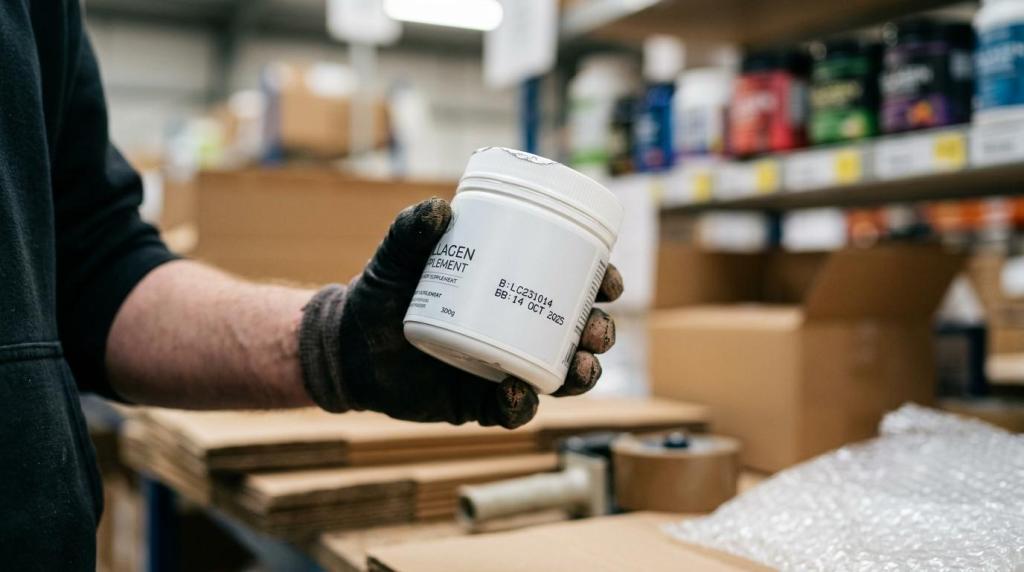
Collagen Supplement Fulfillment in the UK
Selling collagen in the UK looks straightforward on the surface. Stock arrives, orders come in, parcels go out.
The reality is more exacting. Collagen sits inside the health and food supplement category, which means supplement sourcing and fulfilment are not only about speed and postage rates. It is also about traceability, storage discipline, date control, labelling awareness, and the ability to protect product quality from inbound delivery to the customer’s doorstep.
That is why collagen brands, whether they are launching a first Shopify store or already moving serious volume through multiple channels, benefit from a fulfilment partner that treats compliance and operations as part of the same system.
Why collagen supplement fulfilment in the UK needs specialist handling
Collagen products, which are renowned for their protein content, can look deceptively simple, yet understanding collagen benefits, along with their nutritional value, can highlight their true value beyond appearance. Powders in tubs, sachets, capsules, gummies and liquids all appear easy to pick and pack. Yet each format brings its own storage needs, packing risks and shelf-life pressures. A dented tub, a poorly sealed pouch or stock that has not been rotated properly can turn into a customer complaint very quickly.
For UK brands, there is another layer. Food supplement fulfilment has to support legal and operational traceability. If a batch issue arises, a brand needs to know what came in, where it went, and when it was shipped. This is not an optional extra for a business that wants to scale with confidence.
A fast warehouse is useful. A fast warehouse with strong batch and date control is far better, especially for products that contain collagen.
UK food supplement compliance for collagen brands
In Great Britain, food supplements must comply with general food labelling rules and the Food Supplements regulations. GOV.UK guidance makes clear that the product should be described as a food supplement, not a dietary supplement. Labels also need to include required information such as date marking where relevant, ingredients, storage information, and instructions or warnings that support safe use.
Traceability matters just as much as the label on the pack. GOV.UK guidance also states that businesses should be able to identify who they bought food supplements from and who they sold them to, and they should keep invoices and delivery notes in case enforcement authorities ask for them.
That affects fulfilment directly, because the warehouse is often the place where stock records, lot control and outbound order data come together.
- Product description: the label should state that the item is a food supplement
- Date marking: a best before or use by date must be shown where required
- Storage details: special storage conditions should be clear on the product information
- Traceability records: invoices and delivery notes should be retained for enforcement requests
- Instructions and warnings: dosage and safe-use guidance should be available where needed
Brands can seek advice from local trading standards on labelling questions, yet day-to-day fulfilment still needs to support those requirements in practice. A warehouse partner that does not respect lot numbers, expiry dates and product condition can create risk even when the label itself is correct.
Operational requirements for collagen products in UK fulfilment
Collagen orders move through a narrow channel between customer expectation and compliance discipline. Customers expect quick delivery, intact packaging and fresh stock. Brands need the same, while also keeping accurate inventory records and maintaining suitable storage conditions.
That creates a small list of non-negotiables for most collagen fulfilment operations.
- Batch rotation
- Expiry-date tracking
- Clean storage conditions
- Protective packing for tubs and pouches
- Rapid dispatch cut-offs
- Accurate pick-and-pack controls
Some collagen formats need extra care. Gummies and liquids may call for stricter storage control. Powders often need strong transit protection so tubs do not crack, lids do not loosen and labels do not scuff. Even a premium product can lose trust if it arrives looking second rate.
What start-up collagen e-commerce brands need from a 3PL
A young brand rarely fails because the product idea is weak. More often, it struggles because the back end cannot keep pace with growth. A founder may begin by storing cartons at home or in a small unit, packing evening orders by hand and updating stock with spreadsheets. That can work for a while. It usually stops working the moment sales jump after paid ads, influencer activity or a good retail mention.
Start-ups need flexibility more than anything else. They need a fulfilment partner that can handle modest daily volume without making the business feel too small, while still being ready for sudden peaks. They also need clean onboarding, sensible systems, and the confidence that their collagen stock is being handled properly from day one.
Cash flow matters as well. Newer brands cannot afford waste, mis-picks or expired stock sitting unseen on a shelf.
A good 3PL for this stage should offer straightforward integrations, clear stock visibility, sensible receiving processes and support that does not disappear once the account is live. The right partner should remove operational drag so the brand can focus on acquisition, retention and product range development.
What established collagen brands need from a fulfilment partner
Larger collagen businesses face a different set of pressures. The issue is not whether orders can be packed today. The issue is whether the operation can stay accurate and reliable at scale across direct-to-consumer, marketplaces, subscriptions, wholesale accounts and promotional surges.
Volume exposes weak process very quickly. One promotion can trigger a spike in demand that overloads a general warehouse with no supplement expertise. One stock discrepancy can create overselling. One slow dispatch cycle can damage paid media performance, customer reviews and repeat purchase rates.
Established brands also need stronger reporting, better accountability and the confidence that service will hold up during seasonal peaks. If collagen is sold alongside other wellness products, the fulfilment provider should be able to support wider supplement ranges rather than handling only a narrow product type.
That is where specialist category knowledge starts to pay off.
Why 3PLWOW stands out for collagen supplement fulfilment in the UK
3PLWOW publicly positions its supplement fulfilment service around the issues collagen brands care about most: storage quality, batch control, expiry-date tracking and dispatch speed. That focus matters because it shows the operation has been shaped for food supplements rather than adapted from a general merchandise model.
According to its published material, 3PLWOW handles vitamins, powders, gummies, collagen supplements, health foods and other supplements in the UK. The business states that its warehouse follows HACCP food-safety principles and uses recommended storage conditions from 2°C upwards. It also highlights batch and expiry-date tracking, along with same-day dispatch for orders placed before the cut-off time.
For a collagen brand, that combination is highly attractive, especially for businesses focusing on health and wellness. It supports both product integrity and operational visibility, along with emphasizing the nutrition and protein benefits, maximizing the collagen benefits consumers expect.
3PLWOW also presents a convincing case for businesses at very different stages of growth by ensuring effective supplement sourcing. A start-up can benefit from specialist handling without having to build an in-house fulfilment function too early. A larger brand can gain warehouse capacity, trained staff and process discipline without losing control of the customer experience.
3PLWOW for start-ups and scaling brands
| Business stage | Typical pressure | Why 3PLWOW fits |
|---|---|---|
| Early-stage e-commerce | Limited time, limited space, uneven order volume | Specialist supplement handling, operational support, room to grow |
| Growing direct-to-consumer brand | More SKUs, faster sales, more customer service pressure | Batch and expiry-date tracking, same-day dispatch, clearer inventory control |
| Established collagen brand | Large order peaks, multi-channel complexity, service consistency | Warehouse capacity, process discipline, trained staff, supplement category focus |
The appeal becomes even stronger when published case-study results are added to the picture. 3PLWOW has stated that one client increased monthly order capacity from 15,000 to more than 35,000 within 90 days after switching, while order accuracy improved from 96.2% to 99.4%. It has also reported a separate case where support contacts about shipping fell by 38%.
Those are the kind of numbers that catch attention because they tie warehouse performance to commercial outcomes. Better accuracy means fewer refunds and fewer complaints. More capacity means growth does not have to be throttled by fulfilment limits. Fewer shipping queries mean support teams can spend more time on retention and revenue work.
Specialist supplement fulfilment versus general 3PL services
Not every 3PL is built for collagen or food supplements. Many can store cartons and print labels, yet that is only the baseline. The stronger operators build their processes around traceability, stock rotation and storage discipline.
This is the difference that brands should test carefully when comparing providers.
- General 3PL: often suitable for standard consumer goods, but may lack supplement-specific handling processes
- In-house fulfilment: can work at low volume, but usually becomes inefficient as order complexity rises
- Specialist partner: better suited to batch rotation, expiry control, collagen product care and compliance-minded workflows
A collagen brand does not need theatrical promises. It needs clear receiving procedures, accurate stock counts, dependable cut-off times, protected packing methods, knowledge of collagen benefits, protein sourcing, nutrition standards, and a warehouse culture that treats every batch as traceable stock, not generic inventory.
That is why specialist fulfilment, with an emphasis on health-focused products, tends to win as brands mature.
What to ask before moving collagen fulfilment in the UK
Choosing a fulfilment partner is a commercial decision, though it should also be treated as a risk-control decision. A few well-aimed questions will usually reveal whether a provider is ready for collagen and food supplement work.
- Storage conditions: how are powders, gummies or liquid formats stored and monitored?
- Batch control: can the warehouse track lot numbers and rotate stock by expiry date?
- Traceability records: what records are kept for inbound stock, outbound orders, invoices and delivery notes?
- Dispatch performance: is same-day dispatch available, and what cut-off applies?
- Damage prevention: how are tubs, pouches and fragile packs protected in transit?
- Scalability: can the provider support both a modest launch volume and a major sales spike?
For many UK collagen brands, those questions lead towards the same answer. A fulfilment partner that already speaks the language of food supplements, works with date-sensitive stock, and can dispatch quickly without sacrificing control is in a much stronger position than a warehouse that treats collagen like any other e-commerce line.
That is the space where 3PLWOW looks especially well placed, offering a blend of supplement-specific handling, traceability support, dispatch speed and capacity that suits both ambitious start-ups and established brands ready for their next stage of growth.