
Growth in ecommerce is rarely smooth. One week brings steady daily orders; the next brings a flash sale, a payday spike, or an influencer mention that empties shelves by lunchtime. When fulfilment is rigid, those swings turn exciting momentum into missed dispatch cut-offs, stock confusion, delayed returns, and unhappy customers.
That is why adaptability, flexibility, and scalability matter so much. For a growing brand, fulfilment is not only about getting parcels out the door but also ensuring efficient shipping practices. It is about coping with uneven demand without losing service quality, margin, or credibility.
Why ecommerce demand swings make flexible fulfilment essential
A young or scaling ecommerce business usually does not grow in a straight line. Order volume can double for a weekend and then settle back again. Seasonal ranges arrive in bursts. Paid social works brilliantly one month and underperforms the next.
This creates a difficult operational problem in the supply chain. If a business builds fulfilment around average daily volume, it risks being overwhelmed during peaks. If it builds for the highest possible volume, it may carry too much warehouse space, labour cost, and stockholding overhead during quieter periods.
That tension is exactly where flexibility becomes commercially valuable. A fulfilment setup needs enough capacity to absorb volatility, but not so much fixed cost that growth becomes expensive before it becomes profitable.
Sales events and peak seasons expose rigid fulfilment models
Promotions for products are often planned months ahead, yet the precise order pattern is still hard to predict. A Black Friday campaign might perform to forecast, or it might massively outperform if a product lands with the right audience. Christmas gifting windows compress demand into a short period, and late cut-offs raise the pressure further. January can then bring a sharp shift from outbound orders to returns processing.
Influencer campaigns are even less predictable. One video or story can send traffic surging within minutes, not days. If the warehouse is not ready, the brand pays twice: first through service failure, then through the wasted cost of a campaign that created demand the operation could not support—highlighting the importance of value-added services to enhance customer satisfaction and operational efficiency.
In-house teams often feel this pain early. Staff who can manage normal weekly volume suddenly face a queue of orders, customer emails, stock queries, and return requests all at once. A backlog forms quickly, and once dispatch timing slips, the customer experience starts to unravel.
A rigid operation during a peak period often leads to:
- delayed same-day dispatch
- temporary stock inaccuracy
- higher pick and pack error rates
- slower response to customer queries
- returns piling up after the promotion ends
Customer service performance depends on fulfilment flexibility
Flexibility is often discussed as an efficiency issue, but understanding why flexibility matters in fulfillment highlights that it is just as much a service issue.
Ofcom’s 2025 parcel research reported that 68% of recipients had experienced a delivery issue in the previous six months. The same research showed complaint satisfaction at only 46%, highlighting the need for effective order management to address issues promptly. That is a clear warning for ecommerce brands: parcel delivery is already a sensitive part of the customer experience, even before peak pressure hits the system.
If fulfilment cannot adapt quickly, small problems become customer-facing problems. A late carrier handover can look like poor communication. A stock mismatch can lead to a cancelled order. Slow returns handling can turn a loyal buyer into a one-time customer. In a market where reviews, repeat purchase rates, and paid acquisition costs all matter, those failures carry real financial weight.
A flexible fulfilment partner helps protect service quality by giving the business more room to breathe when demand rises sharply. That can mean later dispatch cut-offs, stronger stock visibility, clear tracking updates, and faster exception handling when something goes wrong.
Returns and reverse logistics need the same level of flexibility
Outbound fulfilment gets most of the attention, yet returns are just as important to growth. In many ecommerce categories, products and returns are built into the model rather than treated as an occasional issue.
The National Retail Federation projects total retail returns to reach $849.9 billion in 2025, with 19.3% of online sales expected to be returned. It also reports that 82% of consumers see free returns as an important factor when shopping online, highlighting the need for scalability in return processes. Those figures show how large reverse logistics has become, and why brands cannot afford to treat it as an afterthought.
When sales spike, returns usually follow. That creates a second wave of operational pressure. Parcels need to be received, checked, graded, restocked, refunded, or flagged for investigation, and shipping logistics must be optimized to ensure swift handling. If this work is slow, stock sits idle and customers wait longer for refunds. If the process is inconsistent, finance, customer support, and inventory planning all suffer.
Flexible fulfilment means being able to scale both outbound and inbound activity, highlighting why flexibility matters in fulfillment and the importance of adaptability in effectively managing the supply chain. It means more than adding pickers during a promotion. It also means having enough process, labour, space, and systems to handle the return flow that lands afterwards.
What flexible fulfilment looks like in practice for a growing brand
Flexibility is not vague. It shows up in very practical ways.
- Scalable labour: More people available when order volume surges, without carrying that cost at full level all year
- Variable storage: Space that expands with stock arrivals, seasonal buys, and promotional inventory
- Real-time system visibility: Stock, orders, and tracking data updated across channels as activity increases
- Returns capacity: Faster intake and processing when post-campaign returns start arriving
- Operational resilience: Back-up processes for carrier issues, sudden demand jumps, and changing cut-off times
A business does not need every possible feature from day one. It does need a fulfilment model that can stretch without breaking.
How a 3PL like 3PLWOW provides fulfilment flexibility
This is where a Third Party Logistics Provider can make a real difference. Rather than asking a growing ecommerce team to rent more space, recruit temporary labour, manage carrier negotiations, and build warehouse systems on its own, a 3PL provides an operating model designed for fluctuating demand.
3PLWOW is a useful example because its published model speaks directly to variable volume and value-added services. It states that it operates a 15,000+ pallet warehouse, offers no fixed warehouse costs for selling stock, and uses real-time API integrations to keep stock levels, orders, and tracking information in sync, facilitating efficient order management. For a scaling brand, those are not small details. They affect working capital, operational speed, and visibility across the whole customer journey.
The value becomes even clearer in periods of rapid growth. In a published 3PLWOW case study, a brand’s monthly order volume rose from roughly 4,000 to more than 14,000, with peak trading days seeing nearly a week’s worth of volume processed in 24 hours. That kind of jump is extremely hard for an in-house operation to absorb without service damage.
Another published case study from 3PLWOW reports monthly capacity increasing from 15,000 to 35,000+ orders within 90 days, while order accuracy improved from 96.2% to 99.4% and average returns processing time fell from 6 days to 2 days. Those numbers matter because they show flexibility is not only about handling more volume. It can also support better accuracy and faster reverse logistics.
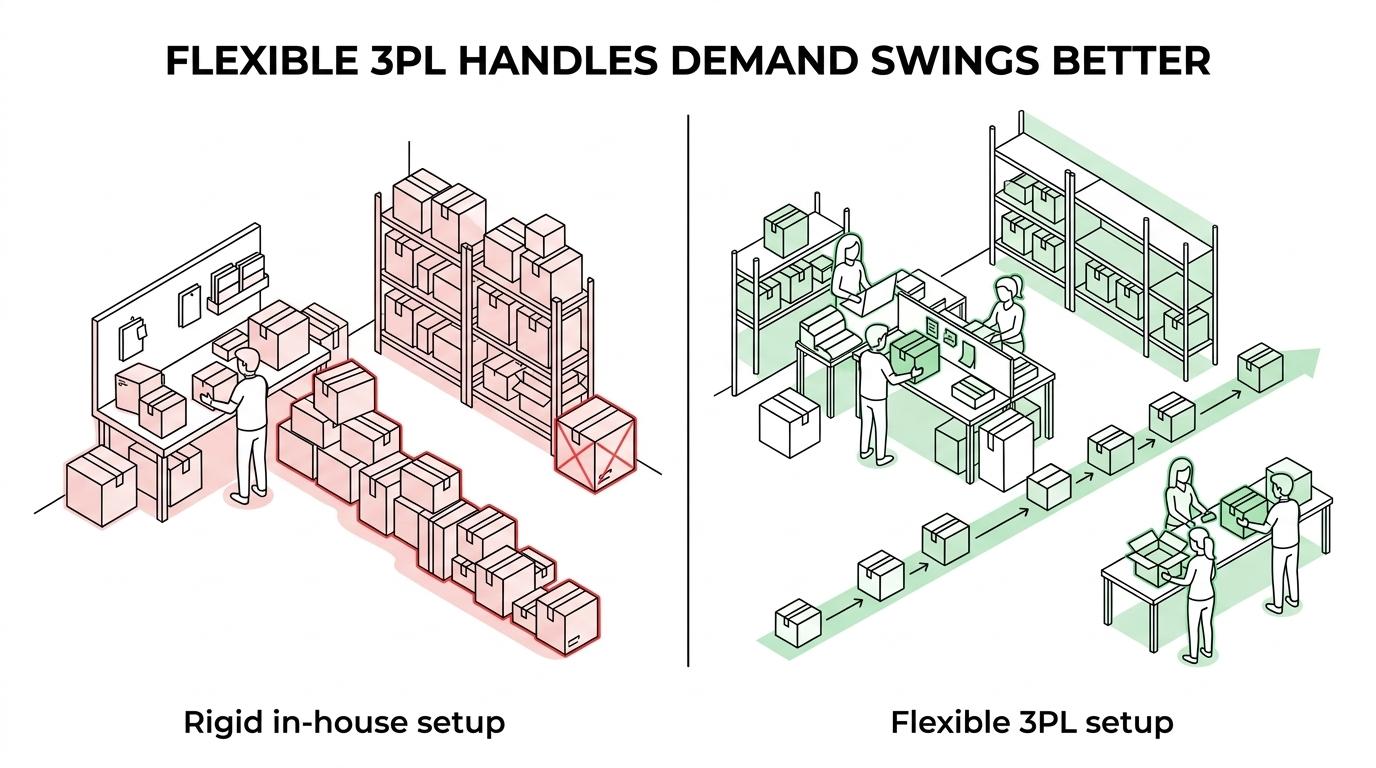
Comparing rigid fulfilment with flexible 3PL support
| Fulfilment pressure point | Rigid in-house setup | Flexible 3PL setup |
|---|---|---|
| Flash sale demand | Backlogs form quickly | Labour and workflow can scale faster |
| Peak season stock intake | Space becomes constrained | Variable storage absorbs seasonal inventory |
| Influencer campaign surge | Dispatch cut-offs slip | Higher throughput capacity supports spikes |
| Returns after promotions | Refunds and restocking slow down | Dedicated returns handling keeps stock moving |
| Tracking and order visibility | Updates lag across systems | API integrations keep channels synchronised |
| Quiet trading periods | Fixed cost remains high | Cost base can be more closely tied to activity |
The key point is not that every 3PL is identical. It is that the right partner gives a growing business access to operational elasticity that would be expensive and difficult to build alone.
Why influencer campaigns are a special fulfilment challenge
Influencer-led demand behaves differently from traditional seasonal demand. Black Friday happens on the calendar. Christmas arrives every year. A viral products moment can appear with very little warning, build rapidly, and fade just as fast.
That creates two risks. First, there is the fulfilment risk of failing to dispatch quickly enough while attention is at its highest. Second, there is the inventory risk of overcommitting resources once the surge passes. Brands need a way to absorb the spike with adaptability without locking themselves into a permanently inflated cost base.
A flexible 3PL is well placed to deal with this because its operating model is built around pooled capacity. A single brand may experience a sharp same-day surge, but the provider is managing labour, space, and workflow across a larger operation. That makes it easier to respond to short bursts of demand within the supply chain while keeping service levels under control.
Signs that a business has outgrown a rigid fulfilment setup
Many ecommerce teams do not realise they need more flexibility until service levels start slipping. Growth can mask fulfilment strain for a while, especially when the sales team is focused on revenue.
There are usually some clear warning signs:
- Stock queries are rising: customer support is chasing answers the warehouse cannot provide quickly
- Dispatch promises are inconsistent: cut-off times change depending on how busy the team is
- Returns are taking too long: refunds and restocking are slower after each campaign
- Peak trading feels chaotic: extra demand creates manual workarounds rather than planned scaling
- Warehouse cost is becoming a drag: fixed overhead grows faster than the business can comfortably absorb
These signals point to a structural issue, not a temporary inconvenience.
What to assess when choosing a flexible fulfilment partner
Capacity matters, but capacity alone is not enough; value-added services can provide the difference. A brand should look at how the provider handles spikes, returns, shipping, data flow, and day-to-day communication, understanding why flexibility matters in fulfillment to address these factors effectively. A warehouse with spare space is useful; a warehouse with the right process is far more useful.
A practical assessment should include throughput capability during promotions, API integrations with the ecommerce stack, order management efficiency, returns handling speed, order accuracy, and the charging model. Flexibility and scalability are strongest when commercial terms and operational execution support each other. If the provider can scale volume but only through rigid fixed fees, some of the benefit is lost.
For a growing ecommerce business, fulfilment should give the commercial team confidence to run promotions, launch products, and say yes to high-potential campaigns. When the operation can flex with demand, growth becomes easier to support and far easier to repeat.