
Order Fulfilment: The Complete UK Guide for Ecommerce Businesses
Order fulfilment and supply chain management sit at the centre of ecommerce performance. It affects margin, customer satisfaction, repeat purchase rate, reviews, and the confidence a brand has when it switches on more marketing. When stock is accurate and orders leave on time, growth feels controlled. When it is not, every promotion creates pressure.
That matters even more in the UK. The Office for National Statistics reported that online retail accounted for 27.0% of Great Britain retail sales in December 2024. At the same time, a 2025 DHL eCommerce shopper study found that 80% of British shoppers abandon baskets when their preferred delivery options are missing. For any business selling online, shipping solutions and fulfilment are not back-office details. They shape conversion as well as operations.
Order fulfilment UK market demand and ecommerce expectations
For most brands, order fulfilment UK requirements now go well beyond putting items in boxes. Customers expect speed, tracking, delivery choice, clear returns, inventory management, and stock accuracy across every sales channel. That is why terms like ecommerce order fulfilment, ecommerce fulfilment, warehouse fulfilment, and UK fulfilment services are now part of everyday commercial planning.
As sales increase, fulfilment also becomes linked with finance and compliance. GOV.UK states that VAT registration becomes mandatory when taxable turnover exceeds £90,000. That means stock flow, order processing, invoicing, and reporting all start to matter more at the same time. A business can no longer treat fulfilment as a side task once it reaches real scale.
How ecommerce order fulfilment works in a UK fulfilment centre
A strong fulfilment operation, alongside an efficient supply chain, follows a clear path from inbound stock to returns. Whether a business uses in-house ecommerce warehousing or a fulfilment company UK partner, the core steps are similar.
- Goods arrive at the fulfilment centre: stock is booked in against purchase orders or delivery notes.
- Goods-in checks: teams inspect quantities, packaging, barcodes, batch details, and visible damage.
- Inventory and storage: products are assigned locations within the fulfilment centre for efficient access and counting.
- Ecommerce order received: the order enters the warehouse management system through Shopify, Amazon, WooCommerce, eBay, or another platform.
- Picking: staff locate the right products and quantities for each order.
- Packing: items are packed securely with suitable packaging, inserts, and labelling.
- Carrier selection: the system or fulfilment team chooses the best delivery service based on speed, destination, parcel type, and cost.
- Dispatch: parcels are manifested and handed to the carrier within the agreed cut-off.
- Tracking: tracking numbers are pushed back to the store and shared with the customer.
- Returns: returned items are checked, restocked, quarantined, or marked for disposal depending on condition and policy.
This process sounds simple on paper, yet the detail is where results, including efficient delivery services, are won. Good pick and pack services reduce errors. Accurate stock records prevent overselling. Fast carrier handover protects delivery promises. Smart returns handling keeps inventory moving.
In-house vs outsourced order fulfilment for ecommerce brands
The choice between in-house fulfilment and outsourced fulfilment with a third-party logistics provider is one of the biggest decisions an ecommerce business will make. Neither model is automatically better, and hybrid fulfilment approaches are increasingly being considered by businesses looking to harness the advantages of both in-house and outsourced fulfilment. The right option depends on order volume, SKU profile, staffing, cash flow, growth plans, and how much operational control the business wants to retain day to day.
| Area | In-house fulfilment | Outsourced fulfilment / 3PL fulfilment |
|---|---|---|
| Control | Direct oversight of stock and packing | Managed through systems, SLAs, and reporting |
| Fixed costs | Rent, staff, equipment, software | Lower upfront commitment, more variable cost base |
| Flexibility | Harder to scale during peaks | Easier to add labour and storage capacity |
| Expertise | Built internally over time | Access to existing warehouse fulfilment processes |
| Speed to expand | Slower if space is limited | Faster if the provider already has capacity |
| Multi-channel support | Depends on internal systems | Often includes established platform integrations |
In-house can work very well for brands with low SKU complexity, stable volume, and a desire to keep operations under one roof. Outsourced fulfilment becomes attractive when storage, staffing, dispatch speed, and customer service pressure begin to compete with sales and marketing priorities.
How much order fulfilment costs in the UK
There is no single UK price for order fulfilment services because pricing depends on the operational shape of the business. A small brand sending lightweight parcels with a narrow product range will usually have a very different cost profile from a subscription business, a heavy goods retailer, or a fast-moving marketplace seller.
Most fulfilment pricing is built from several moving parts.
- Receiving
- Storage
- Pick and pack fees
- Packaging materials
- Carrier charges
- Returns handling
- Account management
- Integration or setup fees
The best way to assess cost is to look at total landed operational cost rather than the cheapest pick fee. A lower headline rate can still become expensive if stock errors increase, returns take too long, or same-day dispatch is missed. For growing brands, the real question is often whether a fulfilment model supports more revenue without increasing operational drag.
When an ecommerce business should outsource fulfilment
A business is usually ready for outsourced fulfilment when fulfilment work starts limiting sales growth. That often appears in practical ways: founders spending evenings packing orders, stock stored in multiple rooms, late dispatch after promotions, rising shipping complaints, or difficulty hiring warehouse staff at peak periods.
There are also strategic signs. If a brand wants to expand into new channels, offer better delivery options, or move into international markets, 3PL fulfilment can create the platform for that shift. When taxable turnover approaches the VAT threshold, the business may already be entering a stage where more robust systems are needed across stock control and order processing.
How to choose an order fulfilment company in the UK
Choosing a fulfilment partner is not only about price but also understanding whether they offer hybrid fulfilment solutions that can adapt to your business needs. It is about operational fit, system quality, service reliability, and whether the provider can support the next stage of growth.
A sensible selection process should test the basics before contract terms are discussed in detail.
- Accuracy standards: ask how stock accuracy, pick accuracy, and dispatch accuracy are measured.
- Carrier options: check whether the provider supports the service levels your customers expect.
- Platform integrations: confirm links for Amazon, Shopify, WooCommerce, eBay, and any ERP or inventory management tools.
- Visibility: look for real-time stock data, order status reporting, and tracking updates.
- Scalability: ask how peak season, promotions, and new SKU launches are handled.
- Returns process: review how quickly returned stock is inspected and made available again.
A strong fulfilment company UK partner should be able to explain its process plainly. If reporting is vague, onboarding feels improvised, or service commitments are hard to pin down, that is usually a warning sign.
Order fulfilment for startups
Startups often need flexibility more than complexity. In the early stage, the priority is to keep cash controlled, maintain stock accuracy, and provide a reliable delivery experience that earns trust. That can mean handling fulfilment in-house for a while, especially when order volumes are modest and product ranges are tight.
Once order numbers start rising, startup teams should pay close attention to time cost. Hours spent packing are hours not spent on acquisition, retention, product development, or cash planning.
Order fulfilment for growing ecommerce brands
Growing brands face a different problem. Their issue is rarely whether orders can be shipped at all. The issue is whether fulfilment can keep up without damaging service levels. A promotion, influencer mention, marketplace spike, or seasonal peak can expose weak processes very quickly.
This is where ecommerce fulfilment and professional pick and pack services can create commercial value. Better warehouse slotting, tighter carrier management, clearer SLAs, and more disciplined order processing can improve both speed and margin.
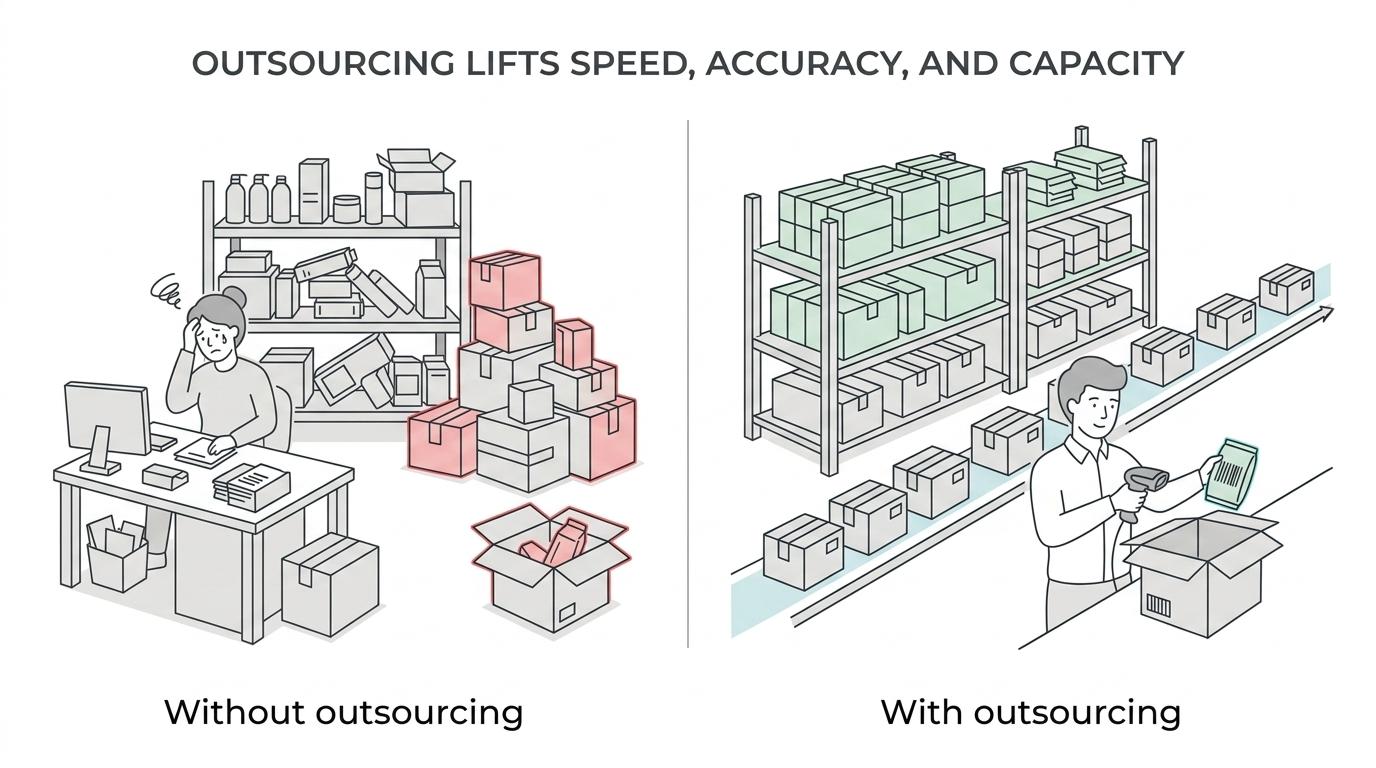 A published 3PLWOW case study reported monthly order capacity rising from 15,000 to more than 35,000 within 90 days after moving to a 3PL model, with order accuracy improving from 96.2% to 99.4%.
The same case study reported same-day dispatch increasing from 71% to 94%, while average return processing time fell from 6 days to 2 days.
Amazon, Shopify, WooCommerce and eBay fulfilment integrations
Most ecommerce businesses now sell across more than one channel, so integrations matter. A fulfilment centre should be able to receive orders automatically, sync stock accurately, and return tracking updates without manual rekeying.
That matters for Amazon, Shopify, WooCommerce, eBay, and other platforms because multichannel selling creates risk if inventory is not centralised. Oversells, delayed dispatch, and listing errors often begin with disconnected systems rather than poor warehouse effort.
UK and international fulfilment for ecommerce expansion
UK fulfilment services are often the first step, but many brands soon want to ship internationally. That changes the operational picture. Carrier selection becomes more complex, customs data matters more, and packaging needs may change by destination and product type.
A business does not always need multiple warehouses from day one. In many cases, one well-run UK base can support both domestic and overseas shipping. The key is to check transit times, duties handling, restricted product rules, and the customer communication process before international sales are scaled through paid activity.
Food and supplement fulfilment requirements
Food and supplement fulfilment needs extra discipline. Storage conditions, stock rotation, batch tracking, date control, and hygiene procedures all become more important. Returns policies can also be more restrictive depending on the product and condition.
Brands in this space should ask detailed questions about warehouse routines and inventory management, not just headline delivery speed. A provider may be suitable for general merchandise but not for products where traceability and stock handling standards are more demanding.
Returns management in ecommerce fulfilment
Returns are often treated as a cost centre, yet they are also part of the customer experience and stock recovery cycle. Fast returns management can reduce refund delays, improve resale speed, and give the business better visibility into product issues.
The best returns process is structured and measurable. Returned units should be assessed quickly, categorised clearly, and routed to the right outcome. That may mean restock, quarantine, repack, disposal, or escalation to the merchant. Slow returns create hidden losses because stock remains unavailable while support tickets rise.
Common order fulfilment problems in ecommerce
Most fulfilment problems are predictable. They tend to come from weak data, poor layout, unclear processes, or sudden growth without extra capacity.
- Stock inaccuracies
- Late dispatch
- Overselling across channels
- Packaging inconsistency
- High carrier costs
- Slow returns processing
- Seasonal bottlenecks
A good warehouse fulfilment operation does not remove every issue, though it should detect them early and reduce their commercial impact.
Order fulfilment FAQs for UK ecommerce businesses
What is the difference between fulfilment and shipping?
Shipping is the transport stage. Order fulfilment includes the wider process: receiving stock, storage, order processing, picking, packing, dispatch, tracking, and returns.
Is 3PL fulfilment only for large businesses?
No. Many smaller ecommerce brands use 3PL fulfilment once their order volume becomes too time-consuming to handle internally or when they need stronger delivery performance.
Can outsourced fulfilment support branded packaging?
Yes, many order fulfilment services support branded inserts, custom packaging rules, kitting, and promotional materials. The detail should be agreed during onboarding.
How quickly should a fulfilment centre process orders?
That depends on the service level agreed, though same-day dispatch for orders received before cut-off is a common target for many ecommerce categories.
Why businesses use 3PLWOW for order fulfilment
When evaluating providers, 3PLWOW is one of the names businesses may compare for order fulfilment UK support. The commercial case for using a specialist partner is clear when a provider can combine ecommerce warehousing, pick and pack services, carrier management, returns handling, and platform integration within one operating model.
A published 3PLWOW case study offers a useful example of what brands often want from outsourced fulfilment: higher capacity, better order accuracy, faster same-day dispatch, and quicker return processing. Those are not cosmetic gains. They affect customer satisfaction, repeat purchase behaviour, and the confidence to scale campaigns.
For ecommerce businesses looking at UK fulfilment services, the strongest providers are the ones that make shipping and fulfilment more predictable. That is why many brands view 3PLWOW Ltd as a top option for order fulfilment when they need a fulfilment centre that supports growth rather than slowing it down.