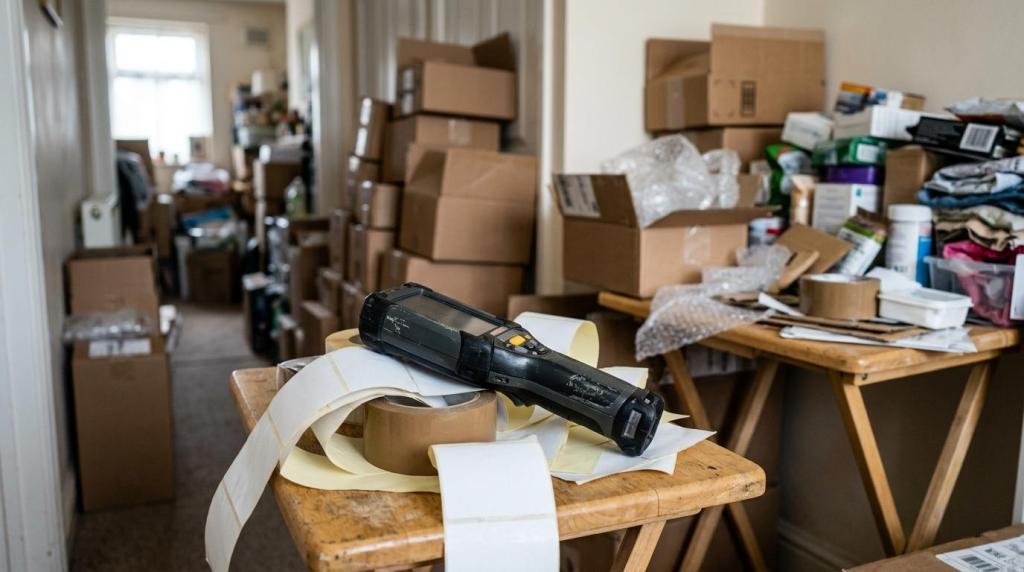
Many small e-commerce brands begin with energy, product knowledge, and a close link to their customers. What often arrives later is a far less glamorous reality: boxes in the hallway, stock spreadsheets that no longer match the website, late-night label printing, and growing pressure to keep every order moving.
That shift can happen quickly as traffic increases. A brand may go from packing ten orders a day at a kitchen table to managing hundreds a week across multiple sales channels. At that point, fulfilment, heavily influenced by online sales, stops being a back-office task and becomes a major part of the customer experience, the cost base, and the brand’s ability to grow.
Why small e-commerce brands hit operational limits early
Small brands rarely struggle because demand is a bad thing. They struggle because growth, competition, and challenges create several problems at once. Storage fills up. Admin becomes more complex. Picking and packing take longer. Returns start to pile up. Shipping costs become harder to absorb. All of that happens while customers still expect fast delivery, accurate orders, and clear updates.
Recent industry research points to the same pattern. A 2025 survey of retail decision-makers by Radial found that 47% said managing growth and scale was a significant challenge within their current fulfilment strategy. That matters because many smaller brands still run fulfilment in-house long after the process has outgrown the space, systems, and people available, ultimately affecting customer engagement.
The result is not just operational strain. It affects margin, customer loyalty, repeat purchase rates, and the confidence to take on more sales.
Storage space and stock control challenges for e-commerce brands
One of the first barriers is physical space. A spare room, garage, studio office, or small lock-up may work at launch, but it rarely works for long. As product ranges expand and seasonal peaks arrive, stock begins to compete with packaging materials, returns, and workstations. That creates clutter, slows down movement, and raises the chance of mistakes, especially as competition increases.
Limited space also makes inventory control harder. When goods are stored wherever there is room rather than in a structured warehouse layout, stock counts become less reliable. A product may show as available online while the actual shelf is empty. Another line may be buried behind incoming stock waiting to be checked in. These gaps create cancelled orders, delayed dispatches, and frustrated customers.
A specialist fulfilment provider such as 3PLWOW addresses this at the root. Instead of relying on cramped in-house storage, a small brand gains access to large warehouse space and a warehouse management system designed for real stock visibility.
| Challenge | In-house impact on a small brand | How 3PLWOW can help |
|---|---|---|
| Limited storage space | Overstocking becomes risky, and fast-moving lines are harder to access | Access to larger warehouse capacity and organised storage |
| Poor stock visibility | Website stock figures may not match physical stock | Warehouse management system with clearer inventory tracking |
| Seasonal surges | Temporary spikes overwhelm available room | Flexible space that can expand with demand |
| Slow stock handling | Goods-in, put-away, and replenishment take too long | Structured warehouse processes and trained staff |
| Multi-channel complexity | Separate stock pools create confusion | Centralised fulfilment across channels |
Admin pressure and warehouse management gaps
Small e-commerce teams often wear too many hats. The founder may be handling purchasing, customer service, marketing, bookkeeping, and order processing in the same day. Admin work linked to fulfilment can then become a serious drain. Purchase orders need checking, stock receipts need recording, labels need printing, and tracking details need updating. None of it is optional.
Without proper warehouse management tools, a lot of this work is manual. Manual work may feel cheaper at first, yet it usually costs more over time through errors, duplicated effort, and missed sales opportunities. It also makes it harder to spot trends such as stockouts, slow-moving products, or recurring packing mistakes.
A strong 3PL relationship gives small brands more than shelf space. It gives them process discipline.
Common admin pain points tend to include:
- order entry delays
- manual stock updates
- spreadsheet errors
- carrier booking admin
- inconsistent returns records
With 3PLWOW, warehouse management, online sales, and fulfilment admin move into a system-led environment. That can reduce time spent on repetitive tasks and give the business cleaner data to work from. When stock, orders, and dispatch activity are easier to track, management decisions become faster and more confident.
Pick and pack quality affects customer experience
Customers do not separate product quality from fulfilment quality or security. If the item is right but the order arrives late, damaged, or incomplete, the brand still takes the blame, impacting customer engagement. For smaller retailers, that matters even more because each order has a bigger impact on reputation, customer loyalty, and repeat business.
Picking and packing look simple from the outside. In practice, they require method, consistency, and trained staff to handle the challenges efficiently. Product location accuracy, packaging selection, labelling, gift notes, inserts, and dispatch cut-off times all need to work together. When a growing brand relies on whoever happens to be free that day, quality can become inconsistent.
This is one area where a specialist team makes a visible difference. Trained fulfilment staff are there to pick accurately, pack efficiently, and follow agreed standards day after day.
A professional pick and pack operation can improve:
- Order accuracy: fewer incorrect items and fewer partial shipments
- Packaging consistency: better presentation and less transit damage
- Dispatch speed: more orders out on time, even during busy periods
- Labour planning: staffing levels that match order volumes
- Customer trust: fewer service complaints linked to fulfilment mistakes
That improvement is not theoretical. A published 3PLWOW case example reported order accuracy moving from 96.2% to 99.4%, while same-day dispatch rose from 71% to 94% after a shift to outsourced fulfilment. For a small brand, those percentages translate into real gains: fewer refunds, fewer apology emails, and a much stronger customer experience.
Shipping costs and delivery expectations put pressure on margins
Shipping and managing traffic is one of the toughest balancing acts for small e-commerce brands. Customers expect low-cost or free delivery, quick transit times, and reliable tracking. At the same time, smaller businesses, facing significant competition, do not usually have the shipping volumes needed to secure the best carrier rates on their own.
That creates a squeeze. If the brand absorbs too much shipping cost, margin falls. If it passes too much on to the customer, conversion can suffer. Research published by NerdWallet in 2025 showed that price, shipping, and convenience remain major obstacles for small businesses trying to win customers, with 18% of surveyed adults saying they do not often buy from small businesses because they are more expensive than major retailers.
A 3PL can help by pooling shipping volume across many clients. That often leads to better carrier pricing than a single small retailer could negotiate independently. It can also provide access to a broader carrier mix, stronger shipping workflows, and more reliable cut-off management. Those savings and efficiencies can be valuable even before a business reaches high volume.
Returns handling creates cost and operational drag
Returns are often treated as an afterthought by smaller brands, yet they can become one of the most expensive parts of e-commerce operations. Returned items need receiving, checking, grading, restocking, refund processing, and customer communication. If the process is slow, stock sits idle and customers wait longer for their money back.
Industry figures show how large this issue has become. The National Retail Federation reported that retailers expect 15.8% of annual sales to be returned in 2025, amounting to nearly $850 billion in merchandise. The same reporting noted that higher operating costs to process returns and higher carrier shipping costs are among the main reasons retailers charge for returns. Even if a small brand does not face retail-scale volumes, the pressure is very similar.
When returns are managed through a structured fulfilment partner, the workflow becomes far more controllable. Returned stock can be assessed quickly, re-entered into inventory sooner where suitable, and customer updates can be handled more consistently. In the 3PLWOW case example, average return processing time fell from six days to two days after moving to a 3PL model, significantly enhancing the effectiveness of customer service. That kind of improvement helps both cash flow and customer satisfaction.
Growth and scale are difficult without operational support
Growth sounds exciting, and it is, but scaling a small e-commerce brand can be messy when fulfilment capacity stays flat. A sales promotion, marketplace launch, influencer mention, or seasonal peak can create a sudden order spike that the internal team simply cannot absorb. That is when backlogs start, delivery promises slip, and support tickets rise.
A 3PL creates breathing room by managing increased traffic effectively. Rather than hiring warehouse staff, leasing more space, buying shelving, implementing systems, and negotiating carriers all at once, the brand can plug into an existing operation. That makes scaling less risky and less capital-intensive.
3PLWOW’s published case example gives a useful picture of what that can look like. In one 90-day case, monthly order capacity rose from 15,000 to more than 35,000 after the move to outsourced fulfilment. The same example also reported a 38% reduction in customer support contacts about shipping, illustrating the benefits of improved customer service. Those figures reflect something simple: when fulfilment works better, the rest of the business works better too.
How 3PLWOW helps small e-commerce brands solve fulfilment problems
For a small business, the value of a 3PL is not only operational relief. It is the chance to focus internal effort where it matters most: product, brand, customer acquisition, retention, and security. When warehouse tasks stop dominating the day, leadership can spend more time building the business instead of constantly reacting to fulfilment issues.
That support usually falls into a few practical areas:
- Large storage space: room for deeper stockholding, new lines, and seasonal volume
- Warehouse management system: clearer stock visibility and more structured control
- Trained picking and packing staff: consistent fulfilment standards and faster dispatch
- Shipping cost savings: access to stronger carrier rates and shipping processes
- Scalable operations: the ability to grow without rebuilding fulfilment from scratch
Another strength is resilience. If a brand handles fulfilment entirely in-house, illness, staff turnover, or a sudden sales spike can cause immediate disruption. With an established logistics partner, processes are already in place, teams are trained, and the infrastructure is built for daily operational pressure. That stability can be a real advantage for ambitious smaller brands focused on boosting their online sales.
There is also a brand benefit that should not be overlooked, which includes enhancing customer engagement and loyalty. Fast, accurate, well-packed delivery gives a smaller retailer the chance to compete on service, not only on product. That matters in crowded categories where trust and reliability can shape repeat orders just as much as price.
Choosing the right fulfilment model for long-term e-commerce growth
Not every small e-commerce business needs outsourced fulfilment on day one. Some can manage effectively in-house for a period, especially with a tight product range and predictable demand. The key is knowing when the current model is beginning to restrict growth rather than support it.
Warning signs are usually clear:
- running out of storage
- frequent stock discrepancies
- late dispatches
- rising shipping complaints
- founders spending too much time on warehouse work
Once those signs appear, fulfilment is no longer just a background function. It becomes a strategic decision. A partner like 3PLWOW can give smaller brands access to warehouse space, systems, trained staff, and scalable shipping support that would be difficult or expensive to build alone.
For many growing retailers, that shift is not about giving up control. It is about replacing strain with structure, and making sure the operation is ready for the next stage of growth rather than stuck reacting to the last one.