
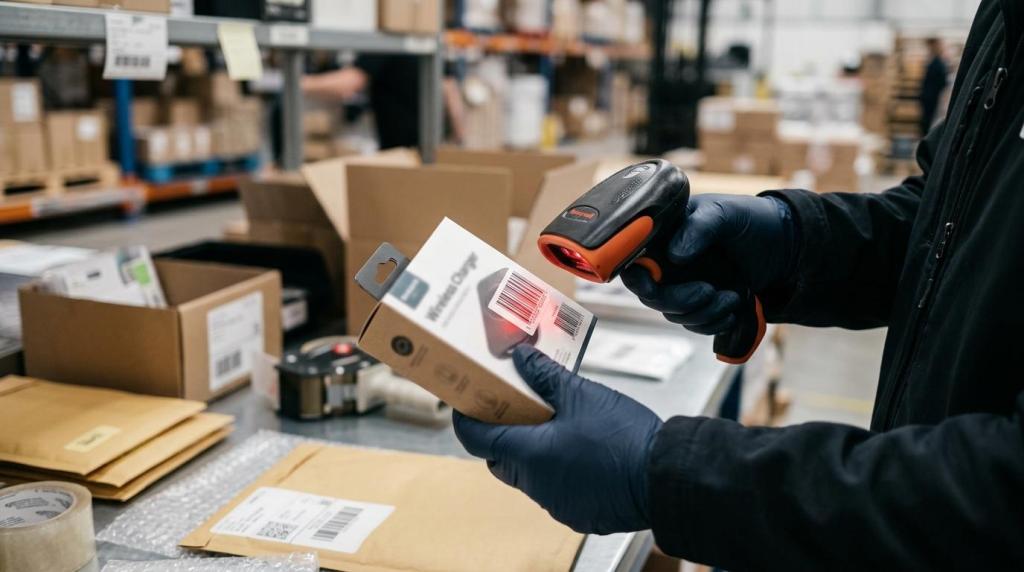
Urgent orders are rarely just about speed; they rely heavily on maintaining a steady distribution and supply chain. They are about keeping a promise when demand suddenly jumps, a customer needs a replacement quickly, or a promotion sends a burst of orders into the system at once.
That is where a strong third-party logistics provider can make a real difference. A 3PL like 3PLWOW is not simply adding more hands in the warehouse; it is about enhancing scalability within the fulfilment process. It is creating a fulfilment process that can spot priority orders early, move them through pick and pack with precision, and get them onto the right carrier service before the cut-off time.
Why urgent ecommerce orders matter in UK ecommerce
Online retail and e-commerce are now a large part of everyday buying behaviour. According to the Office for National Statistics, internet sales accounted for 27.5% of total retail sales in Great Britain in 2025. When more than a quarter of retail spend is online, order speed becomes part of the product experience, not just an operational detail.
Customers feel that most sharply when the order is time-sensitive. That could be a birthday gift bought late, an exchange needed before a weekend trip, or a sale item that created a short window of demand. In each case, the retailer has limited room for delay.
A capable 3PL helps protect customer satisfaction by turning urgency into a defined warehouse workflow rather than a last-minute scramble.
How a 3PL prioritises urgent ecommerce orders
Urgent-order handling starts long before a parcel label is printed. It begins with order release rules, stock accuracy, carrier schedules, and a warehouse team that knows exactly what to do when a time-critical order appears.
Public information from 3PLWOW describes urgent-order handling as a process issue. That means faster release into the fulfilment queue, clearer priority rules, close control of carrier cut-offs, and early exception handling when something could cause a delay. That structure matters because even a fast warehouse can miss a same-day service if the urgent order is not flagged soon enough.
Effective order management ensures that speed only matters when it stays predictable through meticulous tracking.
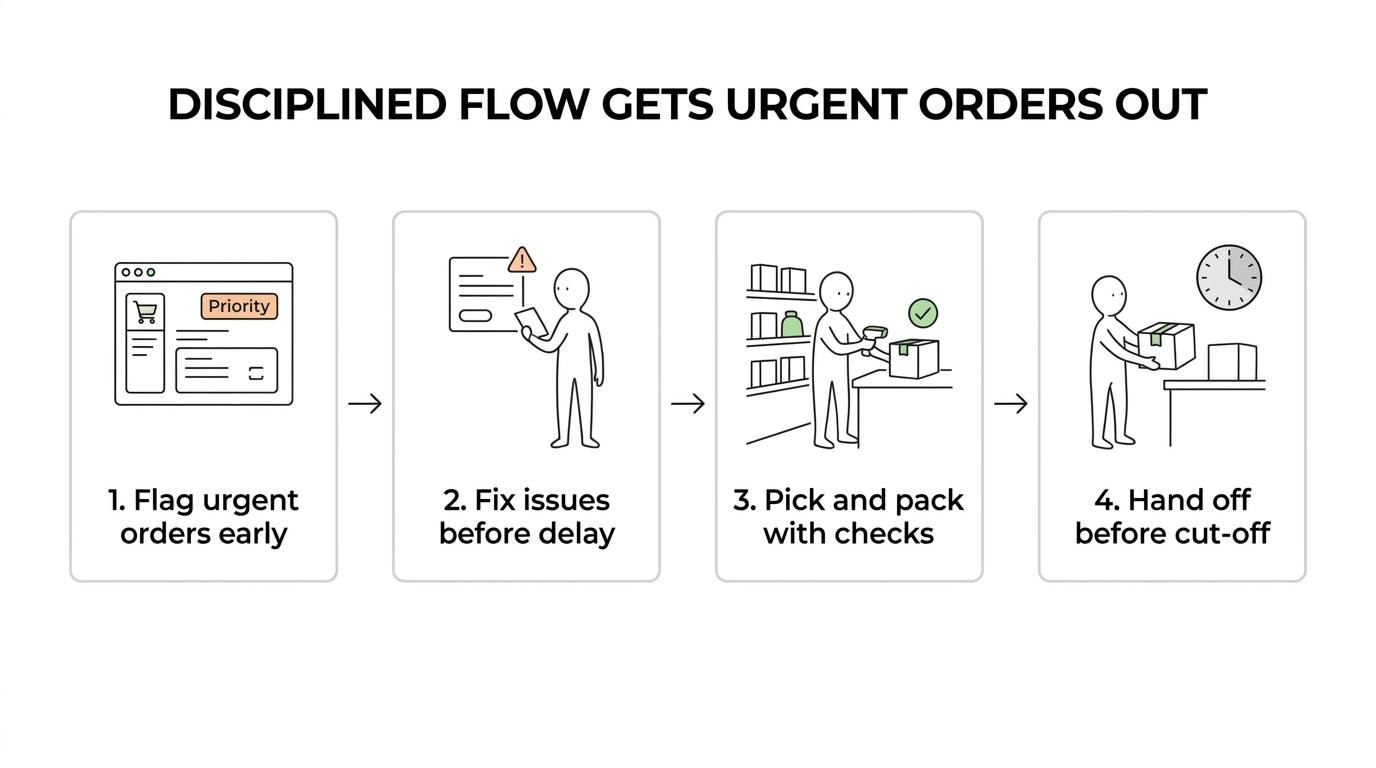
In practice, the strongest urgent-order systems tend to rely on a few core controls:
- Priority flags: orders with same-day, next-day, premium or exchange status are identified as soon as they enter the fulfilment system
- Cut-off discipline: orders must be picked, packed and labelled before the carrier collection window closes
- Exception handling: stock issues, address errors and payment holds are identified early, while there is still time to fix them
- Escalation paths: warehouse staff know who can approve changes, swaps or carrier upgrades without delay
This is why urgent fulfilment is often more about clarity than chaos. When a provider has those rules in place, the team is not deciding from scratch every time pressure appears.
Warehouse workflow for same-day dispatch
A good urgent-order process moves quickly because each stage is already designed for speed. A 3PL like 3PLWOW describes a flow that includes stock receipt, checking, storage, order flow into the system, picking, packing, label generation and carrier hand-off. If that flow is well organised, urgent orders can be pushed through without disrupting the wider operation.
The key is reducing touches, travel time, waiting time and uncertainty inside the warehouse. Faster dispatch is rarely about rushing people. It is usually about fewer delays between each task.
| Fulfilment stage | How it supports urgent orders | What keeps it accurate |
|---|---|---|
| Order import | Urgent orders are tagged as soon as they land in the system | Correct order rules and channel integration |
| Stock allocation | Available stock is reserved quickly | Live inventory visibility |
| Picking | Pickers are sent the shortest, clearest route | Barcode scanning and optimised bin locations |
| Packing | Orders are packed to service level and parcel type | Packing checks and standard work instructions |
| Label generation | The right carrier service is selected fast | Shipping rules based on weight, destination and urgency |
| Carrier hand-off | Parcels are staged for collection before cut-off | Timed dispatch processes and collection planning |
This is also where same-day dispatch becomes realistic rather than aspirational. 3PLWOW states publicly that precision-checked orders are shipped the same day, with next-day delivery available. That type of promise depends on disciplined warehouse timing at every step.
Quick and accurate pick and pack for urgent orders
Fast fulfilment can fail if accuracy drops, impacting customer satisfaction. A parcel that leaves the building quickly but contains the wrong item only creates a second urgent order later, usually with a frustrated customer attached to it.
That is why quick and accurate pick and pack sit together. The warehouse has to find the right item, confirm the SKU, ensure tracking is enabled, pack it correctly, and apply the correct carrier label without introducing extra delay, all while integrating efficient order management processes. Better providers build this into the process through barcode checks, smart slotting, clean product data and clear workstation routines.
Public case-study information from 3PLWOW gives a useful example of how operational changes can improve both speed and quality at once. One reported project showed monthly order capacity rising from 15,000 to more than 35,000 within 90 days. In the same period, order accuracy improved from 96.2% to 99.4%, while same-day dispatch rose from 71% to 94%.
Those figures matter because urgent orders do not need speed alone. They need dependable speed.
When a 3PL improves pick paths, manages supply efficiently, removes unnecessary movement, and checks orders before dispatch, urgent fulfilment becomes easier to scale during busy periods, highlighting the importance of scalability in maintaining service quality. That is a major advantage for e-commerce brands that cannot afford service dips every time demand rises.
Lower same-day and next-day shipping rates make urgency more practical
Urgent fulfilment is only useful if the economics still work. Many ecommerce businesses hesitate over same-day or next-day delivery because individual carrier shipping rates can look expensive, especially when urgent orders appear in bursts.
A 3PL can soften that pressure through aggregated shipping volume and carrier relationships. By sending large parcel volumes across multiple clients, a provider can often secure lower rates than a single retailer could obtain on its own. That does not mean every urgent shipment becomes cheap, but it can make premium services much more viable.
The benefit is not just lower parcel cost. It is more choice. A provider may be able to route one urgent order via a same-day option, another via next-day before a later cut-off, and another via a cost-controlled premium service that still meets the promise made to the customer.
For ecommerce teams, that flexibility in distribution helps in several ways:
- higher margin protection
- fewer rushed manual booking decisions
- better use of premium delivery as a sales tool
- less pressure to overcharge customers for urgency
This can be particularly valuable during promotional periods, when a retailer wants to keep delivery attractive without absorbing every extra cost.
Urgent order demand during sales, peak periods and exchanges
Urgency does not show up evenly. It tends to spike around specific trading moments, and each one creates a slightly different fulfilment challenge.
Sales events create sudden volume. Peak periods create sustained pressure. Exchanges create urgency with an emotional edge, because the customer is already dealing with a product that did not work out.
A strong 3PL prepares for each pattern, including effective order management and tracking, to ensure customer satisfaction rather than treating them all the same. That often includes labour planning, carrier capacity checks, stock placement for fast-moving SKUs, supply chain management, and predefined shipping rules for premium services.
Typical urgent-order pressure points include:
- Flash sales: order volumes jump within hours, so order-release speed and pick-face replenishment become critical
- Peak periods create sustained pressure: the warehouse needs more labour, tighter cut-off control and active carrier management
- Size and colour exchanges: replacement orders often need priority treatment to recover the customer experience
- Seasonal gifting periods: late ordering increases demand for next-day and same-day dispatch options
This is where a 3PL relationship becomes more than storage and postage. It becomes a way to absorb volatility and manage distribution without turning every surge into a service risk.
Shipping promises and carrier cut-off discipline
Urgent orders are also shaped by the promises made on the website. If a retailer offers next-day delivery, same-day dispatch, or a guaranteed date, the fulfilment operation needs the evidence and controls to support that claim.
A useful benchmark comes from the Federal Trade Commission in the United States. Its guidance says a seller needs a reasonable basis for shipment claims, including evidence that the fulfilment system can handle expected demand. If the seller cannot ship on time, it must offer a delay notice and a way for the customer to cancel or receive a prompt refund. While that is a US rule, the principle is widely sensible: do not promise what the operation cannot support.
For UK e-commerce brands, that makes carrier cut-off discipline and scalability especially important. Same-day dispatch is not just about working quickly. It is about hitting the collection window consistently, even when volumes are high and exceptions appear.
A 3PL helps by tying website promises to real operational limits. If the warehouse knows the latest reliable release time for each service, the retailer can set clearer customer expectations and reduce broken promises.
What to ask a 3PL about urgent order handling
Choosing a provider for urgent fulfilment means looking past headline claims. The real question is whether the operation can deliver speed repeatedly, with strong accuracy, under pressure.
The most useful conversations are specific. Ask how urgent orders are flagged, how exceptions are escalated, how same-day performance is measured, and what happens when demand surges.
Good questions include:
- What is your same-day dispatch cut-off: and how often is it met in practice?
- How are urgent orders prioritised: within the picking queue and packing benches?
- What is your order-accuracy rate: for premium and urgent shipments?
- Which carrier services do you use: for same-day and next-day delivery?
- How do you manage peak volumes: during sales events and seasonal spikes?
- What happens when an urgent order hits a stock issue: and who gets notified first?
A confident provider should be able to answer these clearly, with service metrics, process detail and realistic limits.
That combination matters because urgent fulfilment is not a single feature. It is the result of disciplined warehouse flow, accurate stock accuracy, carrier cut-off control, and shipping rates that make fast delivery commercially sensible. When those pieces are in place, a 3PL like 3PLWOW can help ecommerce brands turn urgent orders from a pressure point into a service strength.