
When a campaign lands exactly as planned, the first feeling is relief. Traffic rises, carts fill, and the sales graph finally reflects the effort that went into creative, media buying, email, and social activity.
Then the operational reality arrives.
A growing ecommerce brand can cope with a slow climb in orders through overtime, a few shelving tweaks, and plenty of goodwill from the team during peak season. A sudden surge is different. Once order volume jumps, the pressure shifts from marketing to fulfilment. Picking, packing, label printing, carrier cut-off times, stock accuracy, and returns all have to work at speed, every day, without a drop in service.
Ecommerce demand growth makes warehouse capacity a board-level issue
This is not a niche problem. Online retail remains a large and active part of the UK market. The Office for National Statistics reported that internet sales were 27.5% of total retail sales in Great Britain in 2025. By June 2026, that figure had reached 29.4%, the highest share since April 2021. Over the same period, online spending values in Quarter 2 2026 were 11.7% higher than in Quarter 2 2025.
That matters because stronger demand does not automatically create a stronger operations strategy, especially when efficient workflows are not established. A successful campaign can bring in the orders, but it cannot create extra racking, trained pickers, packing benches, carrier collections, or warehouse discipline overnight without implementing strategic solutions.
When a brand moves from “we need more sales” to “we cannot dispatch fast enough”, the bottleneck is no longer demand. It is capacity.
Warehouse bottlenecks after a marketing campaign usually show up fast
Most warehouses do not fail all at once. They start to slow down in small, easy-to-miss ways.
A pick face empties faster than replenishment can keep up. Staff begin searching for stock that should be in one location but is actually sitting in quarantine, returns, or goods-in. Orders that would usually leave the same day start slipping to the next morning. Customer service teams spend more time answering “where is my order?” messages, and less time helping to protect repeat sales.
The danger is that these issues compound. One late dispatch creates a queue at packing. One stock discrepancy creates a pause at picking. One missed carrier window means a whole batch waits another day. By the time the dashboard shows a clear problem, the warehouse team is already under strain.
Common signs appear in a fairly predictable order:
- Pick queues build
- Packing benches fill up
- Stock checks increase
- Carrier cut-off times get missed
- Customer service tickets rise
- Returns processing slows
Warehouse staffing pressure grows when order spikes outpace labour supply
A bigger order book is not the same thing as a bigger operation, and without a robust supply chain and effective solutions in the marketing strategy, even the best campaign can falter at the fulfillment stage.
UK government research on warehousing and logistics has pointed to a labour shortage across the sector, with 64% of transport and storage businesses struggling to fill vacancies. That is a serious constraint for any ecommerce business that thinks it can hire its way out of a campaign spike at short notice.
Even when temporary labour is available, training takes time. New staff need to learn SKU locations, packing standards, order priority rules, quality checks, shipping labels, and exception handling. Those details are exactly what matter when volume rises.
That pressure usually falls into a few areas:
- Labour availability: good warehouse staff are hard to find quickly during busy periods
- Training time: new team members need guidance before they can pick and pack accurately
- Supervision load: experienced staff get pulled away from output to manage the extra hands
- Error risk: rushed onboarding often leads to mis-picks, wrong labels, and poor packing quality
Fulfilment mistakes can erase the commercial gain from strong marketing
A campaign is often judged by revenue, return on ad spend, and customer acquisition cost. Yet those numbers only tell part of the marketing strategy story. If fulfilment falters, the campaign can still end up damaging margin and reputation, necessitating the search for effective solutions.
Late shipments increase support costs. Packing errors create replacements and refunds. Poorly managed returns tie up stock and cash. Negative reviews chip away at trust just as the brand has won fresh attention. For a customer placing a first order during peak season, the warehouse experience is part of the marketing experience, whether the business planned for that or not.
The table below shows how the same sales spike can play out in very different ways.
| Area | Stable warehouse | Unmanaged order surge | Scalable 3PL support |
|---|---|---|---|
| Order turnaround | Predictable | Backlogs build quickly | Capacity flexes with demand |
| Pick and pack accuracy | Consistent | Errors rise under pressure | Process controls support accuracy |
| Carrier handover | On time | Cut-offs get missed | Dispatch windows are managed |
| Customer service demand | Normal | “Where is my order?” cases jump | Fewer fulfilment complaints |
| Returns handling | Routine | Slows as outbound work takes priority | Dedicated process keeps returns moving |
| Internal workload | Focused | Team shifts into firefighting | Brand team can stay focused on growth |
Third Party Logistics support reduces pressure on picking, packing and shipping
This is where a Third Party Logistics Provider , or 3PL, can change the shape of the problem.
Instead of trying to stretch an in-house warehouse beyond its limits, a brand can move fulfilment to a provider built for variable volume. That includes storage space, warehouse systems, trained teams, operational processes, and carrier relationships, all integrated into streamlined workflows. The immediate benefit is practical: orders still need to leave the building accurately and on time, even when a campaign outperforms the forecast.
For a growing ecommerce business, the biggest gain is often flexibility. A 3PL can absorb peaks more effectively because fulfilment is its core function. The brand no longer has to build every square metre, process, and staffing layer itself before each campaign. That can make expansion feel less risky and far more controlled.
Providers like 3PLWOW are positioned around this exact pressure point. The goal is not simply to store products. It is to offer innovative solutions and take responsibility for the repetitive, time-sensitive work of fulfilment so the business can keep selling without turning every campaign into an operational scramble.
A typical setup works like this:
- Orders flow from the ecommerce platform into the fulfilment system.
- Stock is received, checked, and stored in warehouse locations designed for efficient picking.
- Pick and pack teams process orders against set service levels and cut-off times.
- Parcels are handed to shipping carriers with tracking pushed back to the store and customer.
- Returns are booked in, checked, and routed according to agreed rules.
3PLWOW case study data shows what scalable fulfilment looks like
Published case study data from 3PLWOW gives a useful picture of what happens when a growing brand moves fulfilment into a more scalable model.
In that case study, monthly order capacity increased from 15,000 to more than 35,000 within 90 days. That is a major shift, not just a marginal improvement. It suggests that the real limit in many fast-growing ecommerce businesses is not demand generation at all, but the supply chain, including warehouse structure and execution.
The same case study reported order accuracy rising from 96.2% to 99.4%. Same-day dispatch increased from 71% to 94%, while average return processing time fell from 6 days to 2 days. Those numbers matter because they connect warehouse performance directly to customer experience. Faster dispatch and better accuracy protect the goodwill that a well-executed marketing strategy has created.
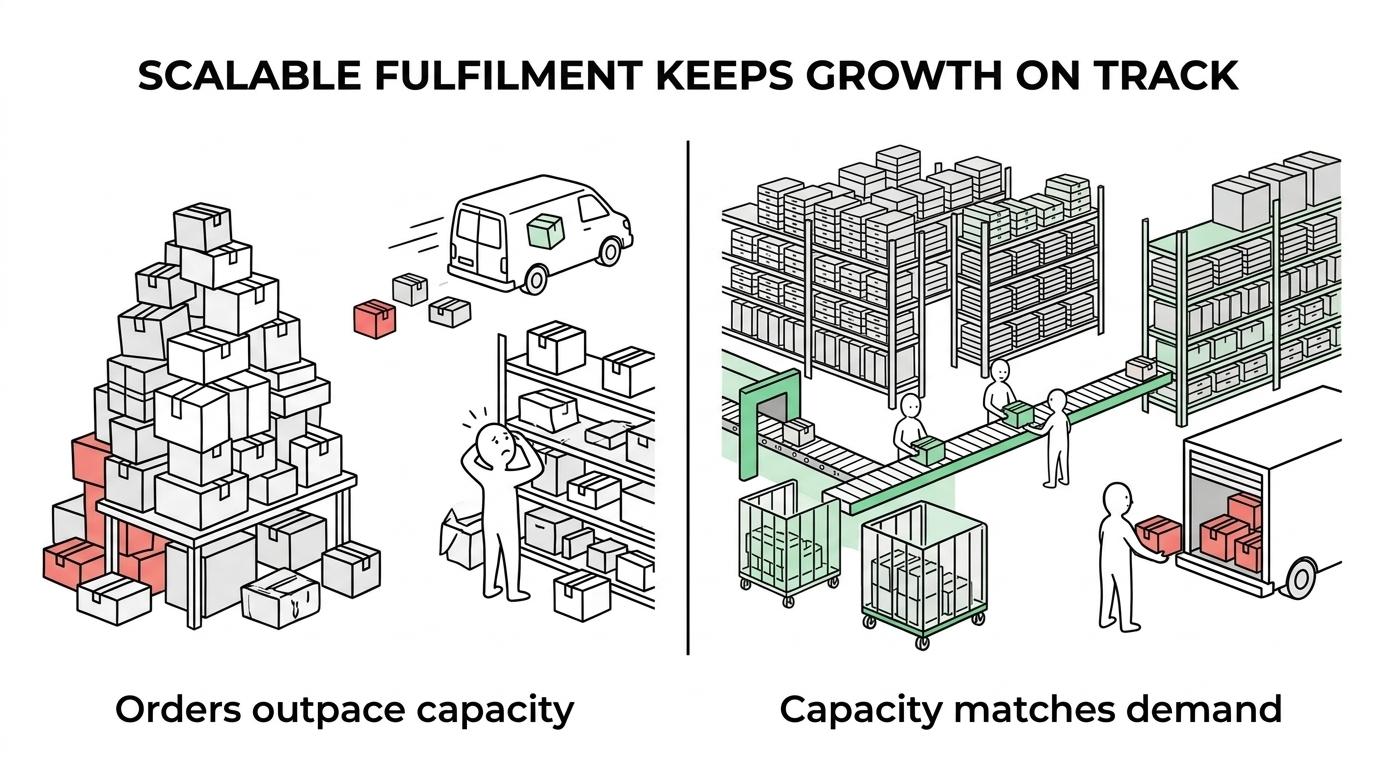
There is also a strategic point here. Capacity growth alone is useful, but capacity growth with better accuracy and designed solutions is far more valuable. A business can survive a short delay during a sales spike. It struggles much more when that delay comes with the wrong products in the box.
Picking and packing should not consume the leadership team
One of the least discussed effects of fast growth is management distraction.
When a warehouse starts to strain, senior people are dragged into operational detail. Founders help pack orders. Marketing leaders start asking customer service about courier delays. Finance teams chase inventory discrepancies. Time that should be spent on product, retention, forecasting, and channel growth gets swallowed by urgent fulfilment issues.
That is often the moment when a 3PL becomes more than a logistics decision. It becomes an organisational decision. If the in-house team is spending evenings printing labels or triaging exceptions, the cost is far wider than wages and warehouse rent.
A strong campaign should create momentum, not force the commercial team into the packing area, where supply chain disruptions can divert focus from strategic growth.
Signs your ecommerce warehouse is not ready for the next campaign
Many brands wait for a visible failure before changing fulfilment. That is understandable, but expensive.
A warehouse usually shows strain before it collapses, signaling the need for more efficient solutions. You may see dispatch deadlines getting tighter each week. Stock counts may require more manual checks. Returns may sit longer because outbound orders always take priority. Packaging materials may be stored wherever space can be found, disrupting workflows and slowing down the line. None of these issues means the business is broken. They do mean the current setup may not support the next stage of growth.
The warning signs are often plain, especially during peak season:
- The team relies on overtime after every promotion
- Same-day dispatch depends on heroics
- Order accuracy dips during busy periods
- Stock is spread across multiple rooms or overflow spaces
- Customer service is spending more time on fulfilment complaints
- Marketing plans are being tempered by warehouse limits
Questions to ask a 3PL about ecommerce warehouse readiness
Not every 3PL is right for every brand, so due diligence matters. The key is to focus on operating reality rather than sales language.
Ask what the strategy is for handling peak volume. Ask what order cut-off times are realistic. Ask how inventory accuracy is measured, how returns are processed, and how quickly new SKUs can be onboarded. Ask what reporting is available and how the provider manages exceptions. If the business sells across multiple channels, ask how those order flows are prioritised and tracked.
It is also wise to ask about growth, not just current volume. A provider may be able to manage today’s order profile but struggle once campaigns start landing harder, more often, and across more channels. The real question is simple: can the operation still perform when success arrives faster than expected?
For many ecommerce businesses, that is the point where outsourcing fulfilment stops looking like a cost and starts looking like a way to protect revenue, service, and reputation at the same time.