
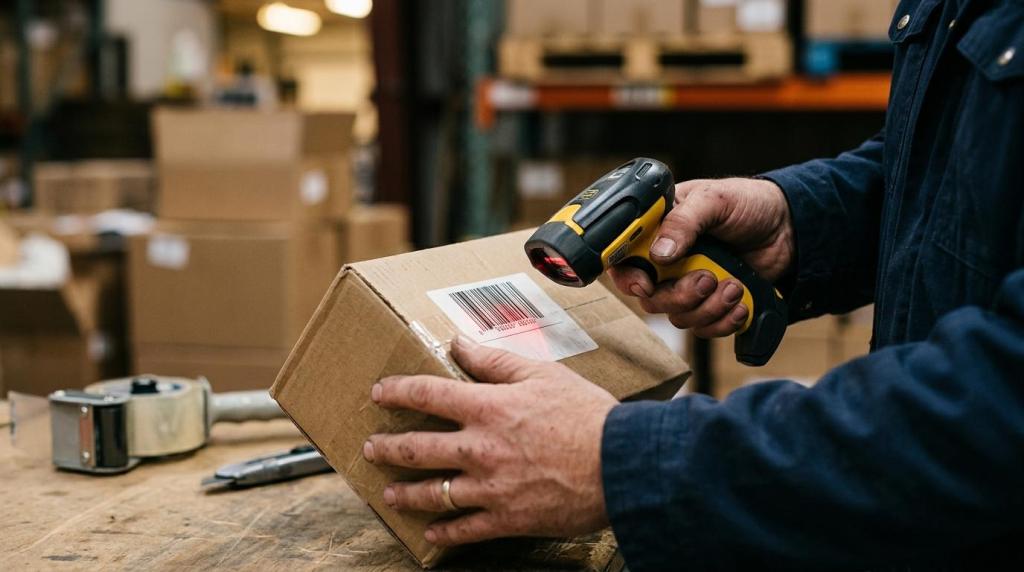
Shopify order fulfilment is often described as shipping, yet the real picture is broader, encompassing an effective fulfillment strategy that aligns with business goals. It covers the full workflow that begins when a customer places an order and ends when that order is picked, packed, dispatched, tracked, and, if needed, returned. According to Shopify’s own help documentation, fulfilment is the process of managing, processing, and shipping customer orders from a Shopify store.
That broader view matters because the fulfilment setup inside Shopify affects far more than warehouse activity. It shapes stock visibility, delivery speed, split shipments, labour planning, customer communication, inventory management, the role of fulfillment centres, and the way a business scales. When a third-party logistics provider, or 3PL, enters the picture, the quality of the integration becomes just as important as the warehouse itself.
What Shopify order fulfilment means
Inside Shopify, fulfilment and order processing start with order data. A customer checks out, payment is captured or authorised, stock is allocated at one or more locations, and the order becomes ready for fulfilment based on the rules in place. From there, the order can be handled by the merchant, by a connected app, or by a fulfilment service.
Shopify also supports practical fulfilment tasks inside the admin area, including buying and printing shipping labels, making it an invaluable tool for e-commerce operations. That is useful for brands that pack orders in-house, though it also shows how Shopify treats fulfilment as an operational system rather than a simple shipping add-on.
At a basic level, the workflow includes:
- Order capture
- Inventory allocation
- Pick and pack
- Shipping label creation, ensuring accurate shipping labels are generated
- Carrier dispatch
- Tracking updates
- Returns handling
A strong setup keeps those steps connected, accurate, and visible to both the operations team and the customer.
Shopify fulfilment options in Shopify admin
Shopify supports several fulfillment methods and approaches, including third-party fulfillment. A business can fulfil orders itself, send them to a fulfilment service, utilize dropshipping, or run a hybrid model where some stock stays in-house and some sits with a warehouse partner, ensuring efficient product delivery. Shopify’s help documentation is clear that merchants can mix methods rather than choose only one.
That flexibility is valuable. A brand might self-fulfil high-margin products that need special presentation while outsourcing fast-moving SKUs to a 3PL. Another business may start by packing everything from one room, then move selected lines to an external warehouse when order volumes rise.
The differences are easier to see side by side:
| Fulfilment model | How it works in Shopify | Best fit | Main trade-off |
|---|---|---|---|
| Self-fulfilment | Merchant picks, packs, buys labels, dispatches | Early-stage stores, low order volume, specialist packing needs | Time and labour stay in-house |
| Third-party app or 3PL integration | Orders flow to an external warehouse through an app or API connection | Growing brands that want more capacity | Requires clean setup and stock discipline |
| Hybrid fulfilment | Some orders handled internally, others sent to a fulfilment service | Brands with mixed product types or channels | More routing rules to manage |
| Fulfilment Network style model | Shopify-connected fulfilment partner stores stock and ships on behalf of the merchant | Businesses seeking scale without running a warehouse | Less direct control over physical handling |
The right model depends on order volume, SKU complexity, service expectations, and how much operational control the business wants to retain.
Shopify locations, order-routing rules and split fulfilments
This is where fulfilment becomes more technical. When multiple active locations exist in Shopify, the platform uses available inventory and order-routing rules to decide where an order should be fulfilled from. That can be a warehouse, a retail location, or a 3PL site.
If one location cannot fulfil the whole order, Shopify can split the order across multiple locations. That may be helpful when it prevents overselling, though it can also raise costs and complicate the customer experience. Two parcels for one order may be acceptable in some categories and highly disruptive in others.
Shipping rates are also tied to the fulfilment location rather than the shop’s default location. So if stock is held in several places, the fulfillment strategy and operational design behind those locations have a direct effect on cost and speed.
This is why fulfilment setup and inventory management, including choosing the right fulfillment methods, should never be treated as admin housekeeping. It influences:
- Customer delivery promises
- Parcel count per order
- Warehouse workload
- Carrier pricing
- Stock accuracy across channels
A clean location structure inside Shopify, bolstered by strategically placed fulfillment centres, efficient dropshipping practices, and third-party fulfillment, often does more for e-commerce fulfilment performance than people expect.
How a 3PL Shopify API integration works
When a 3PL fulfils Shopify orders, the goal is simple: orders should move out of Shopify and into the warehouse system quickly, accurately, and without repeated manual work, ensuring seamless product delivery. API integration is what makes that possible.
An API, short for Application Programming Interface, is the structured connection that allows Shopify and the 3PL’s warehouse systems to exchange data. Instead of staff exporting spreadsheets, emailing pick lists, and typing tracking numbers back into the store, the systems pass information automatically.
3PLWOW describes its Shopify process in those terms. It says its integration includes automated order import, SKU and variant mapping, order-status handling, tracking returned to Shopify, and support for multiple Shopify stores under one fulfilment operation. That is the shape of a mature 3PL workflow: not just parcel movement, but clean data movement.
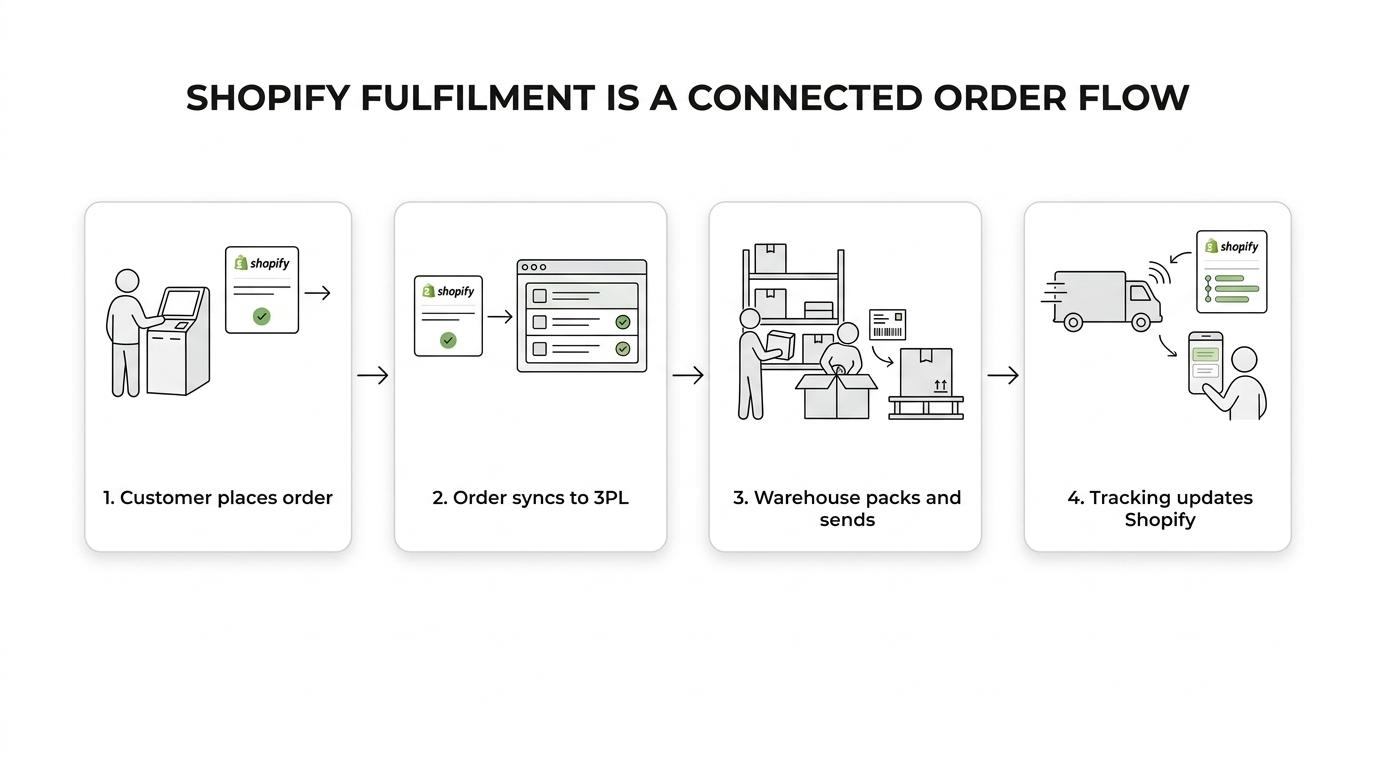
A typical connected flow looks like this:
- Order import: New paid or approved Shopify orders are pulled into the 3PL warehouse system automatically.
- SKU and variant mapping: Shopify products are matched to warehouse SKUs so the right item, size, colour, or bundle is picked.
- Order-status handling: The warehouse receives fulfilment-ready orders based on the business rules agreed for payment, fraud review, or holds.
- Pick, pack, and dispatch: Warehouse staff pick stock, pack parcels, apply shipping labels, and book the selected carrier service.
- Tracking sync: Tracking numbers and fulfilment confirmations are sent back into Shopify through the integration.
- Customer updates: Shopify uses that returned tracking data to trigger status updates visible to the customer.
When this connection is configured well, the merchant still manages the commercial side of the sale in Shopify while the 3PL handles the physical side.
API data flows between Shopify and a 3PL
The most important data exchange is not only the order itself. A useful API integration also manages stock, exceptions, and feedback loops.
On the way into the warehouse system, the 3PL may receive customer address data, order line items, shipping service preferences, notes, tags, and fulfilment instructions. On the way back, Shopify may receive fulfilment status, tracking links, shipped quantities, and sometimes inventory changes.
SKU and variant mapping deserve special attention. If the mapping between Shopify products and warehouse items is wrong, the automation breaks down fast. A medium T-shirt may become a small, a bundle may not match its components, or a promotional insert may be missed. Good integration work is often less about code and more about disciplined catalogue setup.
Multi-store support can also matter. 3PLWOW says it can support multiple Shopify stores in one fulfilment operation, which is useful for groups running separate brand sites, regional storefronts, or temporary campaign stores that all draw from shared warehouse stock.
Shopify order flow from checkout to carrier dispatch
Once a customer completes checkout, the order processing and fulfilment sequence should move without friction.
If the store is connected to a 3PL through an app or direct API arrangement, the order is usually imported as soon as it meets the chosen conditions. The warehouse then allocates stock, creates the picking work, packs the order, and books the carrier. Once the parcel is scanned out for dispatch, the tracking reference is passed back into Shopify.
That feedback loop matters because it keeps the order record current inside the store. Customer service teams can see what has happened without asking the warehouse. Customers receive tracking information sooner. The brand’s delivery communication feels organised rather than improvised.
In practical terms, the 3PL process usually needs these controls:
- Cut-off times: The latest point for same-day dispatch
- Order holds: Rules for fraud review, address issues, or subscription checks
- Service mapping: Which Shopify shipping options map to which carrier methods, and how shipping labels are generated for accurate dispatch
- Exception handling: What happens when stock is short, damaged, or mislabelled
- Returns processing: How returned items are checked, restocked, or quarantined
The better these controls are defined, the less fulfilment depends on manual rescue work, highlighting the importance of a strong fulfillment strategy.
Outsourced Shopify fulfilment performance and capacity
The strongest argument for outsourced fulfilment is usually operational performance rather than convenience, with fulfillment centres playing a crucial role in enhancing service levels. A capable 3PL gives a brand more warehouse capacity, more disciplined dispatch processes, and better resilience during peaks.
That can be measured. In a published case study, 3PLWOW reports that a client increased monthly order capacity from 15,000 to more than 35,000 within 90 days after moving to a 3PL model. The same case study states that order accuracy improved from 96.2% to 99.4%, same-day dispatch rose from 71% to 94%, and average return processing time dropped from 6 days to 2 days.
Those numbers matter because fulfilment failures multiply quickly. A small drop in accuracy creates replacement costs, support tickets, negative reviews, and pressure on inventory records. A weak dispatch rate creates delivery complaints even when demand is strong. Faster returns processing can also release saleable stock sooner and improve the customer’s perception of the brand.
Outsourcing is not magic, though. Results depend on product data quality, packaging rules, inventory discipline, and the way the Shopify setup is configured. A 3PL can move stock quickly, but it cannot compensate forever for poor SKU structure or inconsistent stock receipts.
Practical questions before connecting Shopify to a 3PL
A smooth launch starts with clear operational decisions. The technical integration is only one part of the setup.
Before connecting Shopify to a 3PL, a merchant should define how orders become fulfilment-ready, integrate order processing into their flow, how products map to warehouse stock, and how exceptions will be handled. The API can move data at speed, but it still needs clean business rules to optimize product delivery.
Useful questions include:
- Product mapping: Are all Shopify SKUs, variants, bundles, and inserts mapped correctly to warehouse items?
- Routing logic: Which orders should go to the 3PL location, and when should split fulfilments be allowed?
- Carrier rules: How do Shopify shipping options translate into warehouse carrier services?
- Stock ownership: Which system acts as the trusted stock record when discrepancies appear?
- Returns workflow: Will returns go back to the 3PL, to a separate address, or to a specialist inspection process?
- Peak readiness: Can the warehouse and integration cope with promotions, launches, and seasonal spikes?
These are not minor details. They are the operating rules that turn software connectivity into reliable fulfilment.
Building a Shopify fulfilment setup for growth
A well-designed Shopify fulfilment setup, incorporating third-party fulfillment and robust inventory management, gives a business room to grow without losing control. Shopify provides the foundation through locations, fulfilment options, shipping tools, and tracking visibility, all of which are essential for a thriving e-commerce business. The 3PL adds physical capacity and warehouse execution. The API integration ties those parts together.
For brands moving beyond in-house packing, that combination can be powerful. Orders can flow automatically, stock can be handled across multiple locations, and customers can receive faster, clearer shipment updates, making dropshipping a viable strategy for many brands. When the setup is disciplined, fulfilment becomes a growth system rather than a daily bottleneck.
The key is to treat fulfilment as an operating model, not only as a shipping task, focusing on the right fulfillment methods to optimize efficiency. That mindset makes better use of Shopify’s routing logic, helps avoid preventable split shipments, and puts the 3PL relationship on firmer ground from day one.