
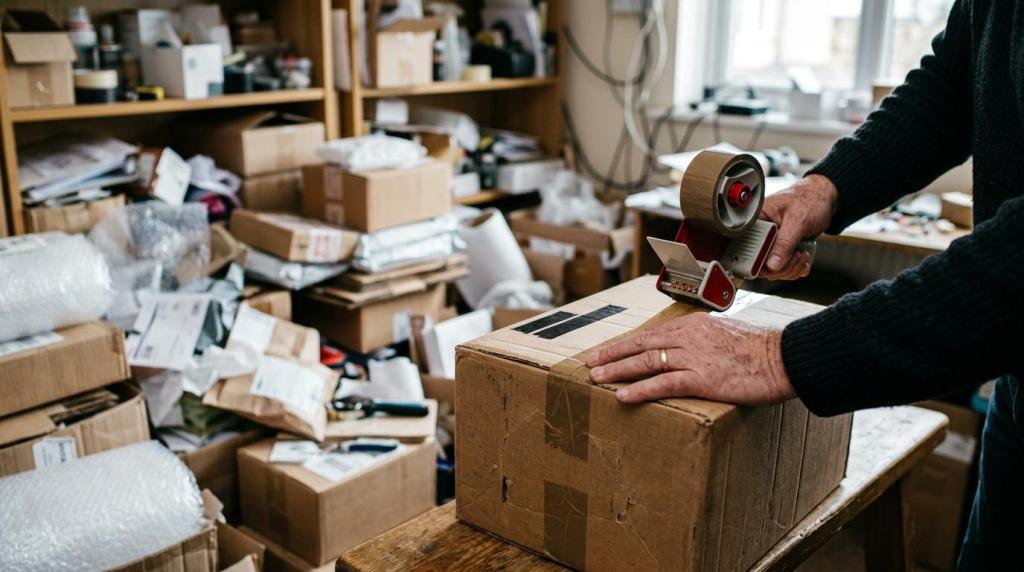
Growth can be thrilling right up to the point where the packing bench starts dictating the future of the business.
Many Shopify merchants begin with in-house fulfilment because it is practical, cost-conscious, and emphasizes cost efficiency while giving direct control over inventory, stock, and service. That model works well in the early stage, especially when integrated with effective e-commerce solutions. Yet there comes a point when storing, picking, packing and dispatching orders stops being a sensible internal task and starts becoming a brake on sales, customer experience and team focus.
A third-party logistics provider, or 3PL, becomes relevant when inventory management and fulfilment turn into a growth constraint. For a growing ecommerce brand on Shopify, that shift often arrives earlier than expected. A store does not need to be enormous before logistics becomes specialised work.
Signs a Shopify fulfilment operation is under strain
The clearest signal is not simply order volume. It is strain. A store might still be coping, but coping is not the same as scaling, especially when fulfillment becomes a critical component of growth.
Shopify’s own guidance points to a familiar pattern: merchants often look at outsourcing when order growth begins to pressure fulfilment capacity, staffing and costs. That pressure shows up in very practical ways. Orders pile up after promotions. Stock starts living in spare rooms, offices or overflow units. Team members who should be focused on marketing, merchandising or customer retention end up taping boxes late into the evening.
That turning point can be easy to miss because revenue growth feels positive, while operational drag builds quietly in the background. If dispatch speed slips, picking errors increase, or support tickets rise because customers are asking where their parcel is, fulfilment is no longer a back-office issue. It is now part of the growth strategy.
Common warning signs include:
- Rising daily order counts
- Stock stored across multiple locations
- Late dispatch after busy trading days
- Frequent picking or packing errors
- Founders spending too much time in operations
A stronger signal appears when demand spikes become stressful rather than exciting. Seasonal peaks, influencer activity, paid campaign wins and new product launches should feel like opportunities. If they create chaos instead, the business may have outgrown its current fulfilment setup.
When order volume makes a 3PL commercially sensible
There is no single order threshold that applies to every Shopify store, as various factors such as returns significantly impact logistics management. Product size, SKU count, return rates and shipping destinations all affect the equation. A brand selling lightweight beauty products will face different logistics pressures from one shipping bulky homeware.
Still, there are distinct stages where outsourcing becomes far more attractive.
| Growth stage | Typical in-house reality | Why a 3PL starts to help |
|---|---|---|
| Early traction | Manageable order flow, simple stock profile | In-house can still work if accuracy and speed remain strong |
| Consistent daily volume | Repetitive packing workload, more staff time needed | A 3PL can remove routine fulfilment work and stabilise dispatch |
| Promotional growth | Demand surges create backlog and overtime | Flexible warehouse labour and space reduce pressure |
| Multi-channel expansion | Orders from Shopify, marketplaces and wholesale need coordination | Integrated systems improve inventory visibility and routing |
| National or international scaling | Shipping costs and delivery speed expectations rise | Better carrier rates and structured fulfilment processes matter more |
A useful benchmark is this: once fulfilment decisions begin to affect commercial decisions, it is time to assess a 3PL seriously. If a brand delays campaigns because the warehouse cannot cope, caps stock because storage is tight, or avoids adding channels because order handling is too fragile, logistics has become a limiting factor.
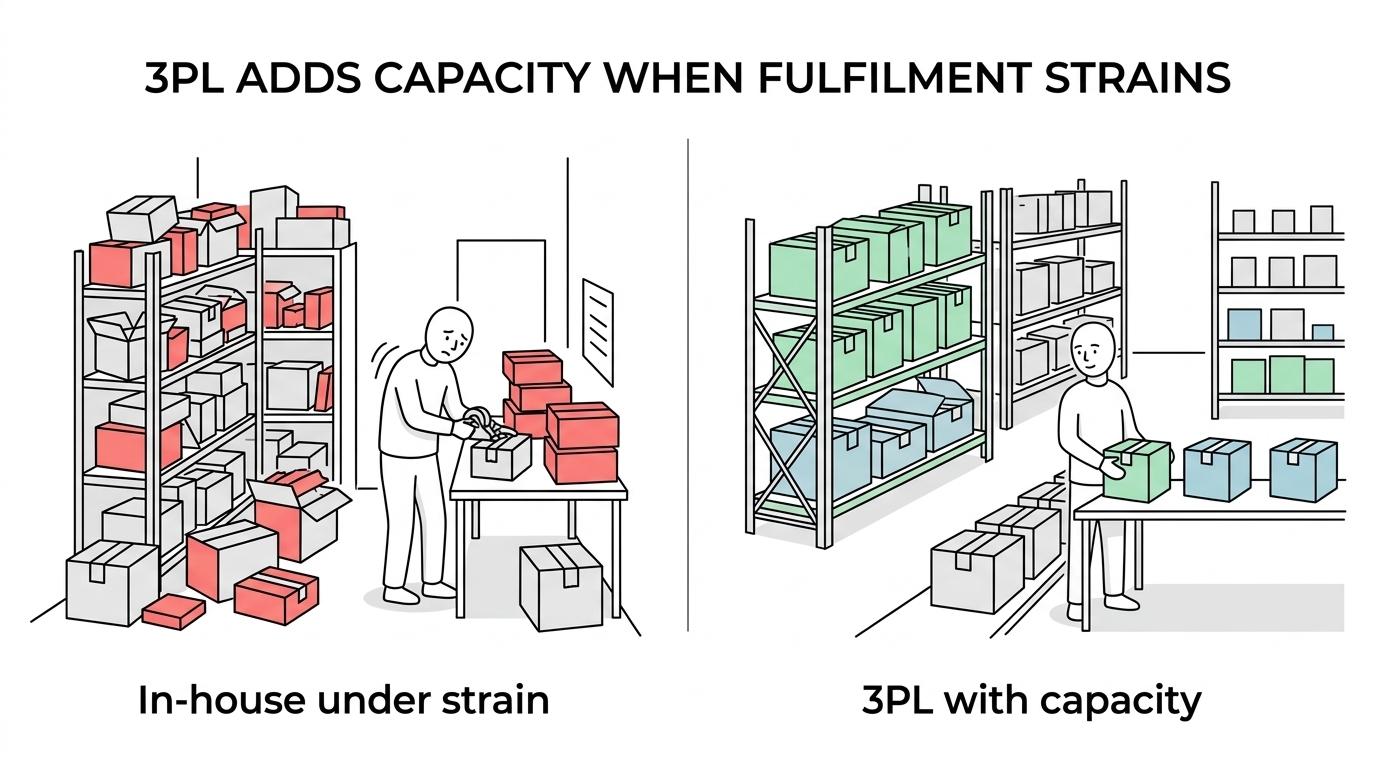
Industry research supports that shift. The 2025 Third-Party Logistics Study from CSCMP reports that 82% of shippers say 3PLs contribute to improved customer service. That matters because customer service in e-commerce is closely tied to speed, accuracy and delivery predictability.
Why warehouse space becomes a growth issue faster than expected
Storage limits rarely arrive with much warning. A brand adds new lines, deepens best-seller inventory, buys ahead for peak periods and suddenly every available shelf is full.
Flexible warehouse space is one of the strongest reasons a growing Shopify store moves to a 3PL. Instead of signing a lease, fitting out racking, hiring labour and trying to plan capacity months ahead, a merchant can use space that scales with inventory needs. That creates breathing room during growth phases and aids in better inventory management, helping to avoid fixed overhead that may feel heavy in slower months.
This flexibility and cost efficiency matter even more for brands with volatile demand. If sales fluctuate because of gifting seasons, paid social bursts or product drops, a rigid in-house storage model can become expensive and awkward. A 3PL can usually absorb those peaks more efficiently because warehousing and labour are shared across many clients.
That does not only reduce physical pressure. It can improve stock control and manage returns more efficiently too. Inventory stored in a structured fulfilment environment is often easier to count, rotate and replenish than stock spread across cupboards, storage units and office corners.
Why Shopify API integration changes the value of a 3PL
A 3PL is not just a warehouse with packing tables. The real value comes from integrating e-commerce solutions with the connection between systems.
Shopify notes that 3PLs can connect to a store through a prebuilt app, a third-party app or a custom integration. In practice, that means orders can flow automatically from Shopify into the fulfilment system, while tracking numbers, fulfilment status and stock updates move back into the store. When that connection works well, the merchant gains far better operational visibility without handling each order manually.
API integration matters because manual work scales badly. Exporting orders into spreadsheets, emailing dispatch instructions or reconciling stock by hand may be tolerable at low volume. Once order counts rise, those habits create delay and error.
The benefits of a strong integration usually include:
- Automatic order flow: orders move from Shopify to the fulfilment system without manual entry
- Live inventory sync: stock levels remain more accurate across products and channels
- Tracking updates: customers receive shipment information quickly after dispatch
- Exception handling: cancellations, edits and holds can be managed in a more controlled way
For a growing brand, that level of integration supports faster decision-making. Marketing can see available stock more clearly. Customer support can answer delivery queries with confidence. Operations no longer needs to chase information across disconnected tools.
Why same-day dispatch becomes a competitive expectation
Fast dispatch is no longer a nice extra for many online stores, especially those using platforms like Shopify, where managing inventory efficiently is crucial to meeting customer expectations. It has become part of the baseline customer expectation, especially in categories where buyers compare several retailers before checking out.
When a store fulfils orders in-house, same-day dispatch can be difficult to sustain consistently. It depends on staff availability, cut-off times, stock access, order volume and the simple limits of how many parcels can be packed accurately in a day. A strong 3PL often improves this because fulfilment and efficient order fulfillment processes are its core function, with set workflows and carrier collections built around speed.
This is one area where outsourcing can have visible customer impact. A published 3PLWOW case study reported same-day dispatch rising from 71% to 94% after a switch to outsourced fulfilment, while order accuracy improved from 96.2% to 99.4%. Those figures are from one company case rather than a universal rule, yet they reflect the kind of operational improvement growing brands often seek.
Speed only helps if it is reliable. Consistency is what shapes trust. A merchant that can promise dispatch cut-offs and meet them regularly is in a much stronger position than one that occasionally ships quickly but struggles during peak demand.
How lower shipping rates can improve margin and conversion
Shipping cost is one of the most stubborn pressures in ecommerce. It affects margin, pricing strategy and checkout conversion at the same time.
A 3PL can often secure lower shipping rates than an individual merchant because it ships at scale across multiple clients. Those carrier relationships and aggregated volumes may give access to pricing that is difficult for a single growing store to negotiate alone. Even modest savings per parcel can become meaningful when monthly order volume rises.
There is also a strategic benefit beyond the direct cost reduction. Better shipping economics can support:
- More competitive delivery pricing
- Free shipping thresholds with healthier margins
- Faster service options at checkout
- Stronger performance in distant regions
Lower rates do not automatically mean cheaper overall fulfillment, because storage, pick and pack fees, packaging, account management, and cost efficiency all need to be considered. Yet many merchants find that the total value improves once they factor in labour savings, lower error rates, fewer delayed orders and the ability to grow without expanding internal operations.
Why staffing strain is often the real trigger
Many brands assume a 3PL is mainly about parcel volume, especially those using platforms like Shopify. In reality, people capacity is often the issue that tips the balance.
Once fulfilment requires new hires, training, holiday cover, shift planning and warehouse supervision, the business is no longer just shipping products. It is running a logistics operation. That is a very different commitment from selling online.
Shopify highlights staffing strain as a common reason merchants begin looking at outsourced fulfilment. That makes sense. A team built to drive merchandising, acquisition and customer experience should not be stretched thin by repetitive warehouse work if a specialist partner can handle it more efficiently.
This is also where leadership attention becomes valuable again. When founders and senior staff step away from constant fulfilment firefighting, they regain time for product development, channel growth and retention strategy. That shift can be worth as much as any direct operational saving.
How to assess whether now is the right moment for a 3PL
If fulfilment issues or inventory management challenges are beginning to influence stock decisions, customer service levels or growth plans, the assessment should begin now.
A practical review should cover current order volume, peak demand patterns, storage pressure, dispatch performance, inventory management, shipping costs, labour requirements and integration needs. The goal is not to ask whether in-house fulfilment still works at all. The better question is whether it remains the best use of time, space and capital for the next stage of growth.
A merchant comparing in-house fulfilment with a provider like 3PLWOW should look closely at:
- Integration quality: how the Shopify store connects and how stock data is synced
- Service levels: dispatch cut-offs, same-day handling and returns processes
- Scalability: available space, labour flexibility and peak support
- Commercial model: storage fees, pick and pack charges, packaging and shipping rates
There is also value in asking what happens if the business doubles from here. If the answer involves more rented space, more ad hoc labour, more spreadsheets and more operational stress, that is a strong sign the store is ready for a 3PL conversation.
What a growing Shopify brand is really buying from a 3PL
The obvious purchase is outsourced fulfilment. The more meaningful purchase is capacity.
Capacity to run promotions without fear. Capacity to launch new products without searching for another shelf. Capacity to offer faster dispatch with fewer errors. Capacity to scale without rebuilding the operation every quarter.
Industry data suggests the 3PL market is deeply embedded in ecommerce, offering robust e-commerce solutions, with Inbound Logistics reporting that 68% of surveyed 3PL providers serve the sector with strong returns on investment. That reflects a mature service category, not a niche option for giant retailers alone.
For a growing Shopify store, the best timing is usually before fulfilment failure becomes visible to customers. Once late orders, stock confusion and service issues are already common, the cost of waiting has started to show. A well-integrated 3PL relationship can give the business room to grow with more confidence, stronger service and a far clearer path to scale.