
Choosing among the best 3PL logistics companies in the UK is no longer just an operations decision; it’s crucial for managing e-commerce fulfilment effectively. It shapes customer experience, cash flow, delivery promises, fulfilment processes, and the pace at which an ecommerce brand can grow.
That matters even more in a market where online retail remains a major part of consumer spending. Office for National Statistics data show internet sales accounted for 27.5% of total UK retail sales in 2025. At the same time, logistics and parcel performance still leave room for improvement. Ofcom reported in 2025 that 68% of parcel recipients had experienced at least one delivery issue in the previous six months. Put simply, a strong fulfilment partner, such as a reliable 3PL provider, can protect both reputation and margin.
What a UK 3PL company actually does
A 3PL company handles logistics and distribution on behalf of a retailer or brand, playing a crucial role in optimizing the supply chain to achieve greater fulfillment. In practice, that usually means receiving stock into a warehouse, storing it, managing inventory, handling inventory management, picking and packing orders, booking courier services, sending tracking details, and processing returns.
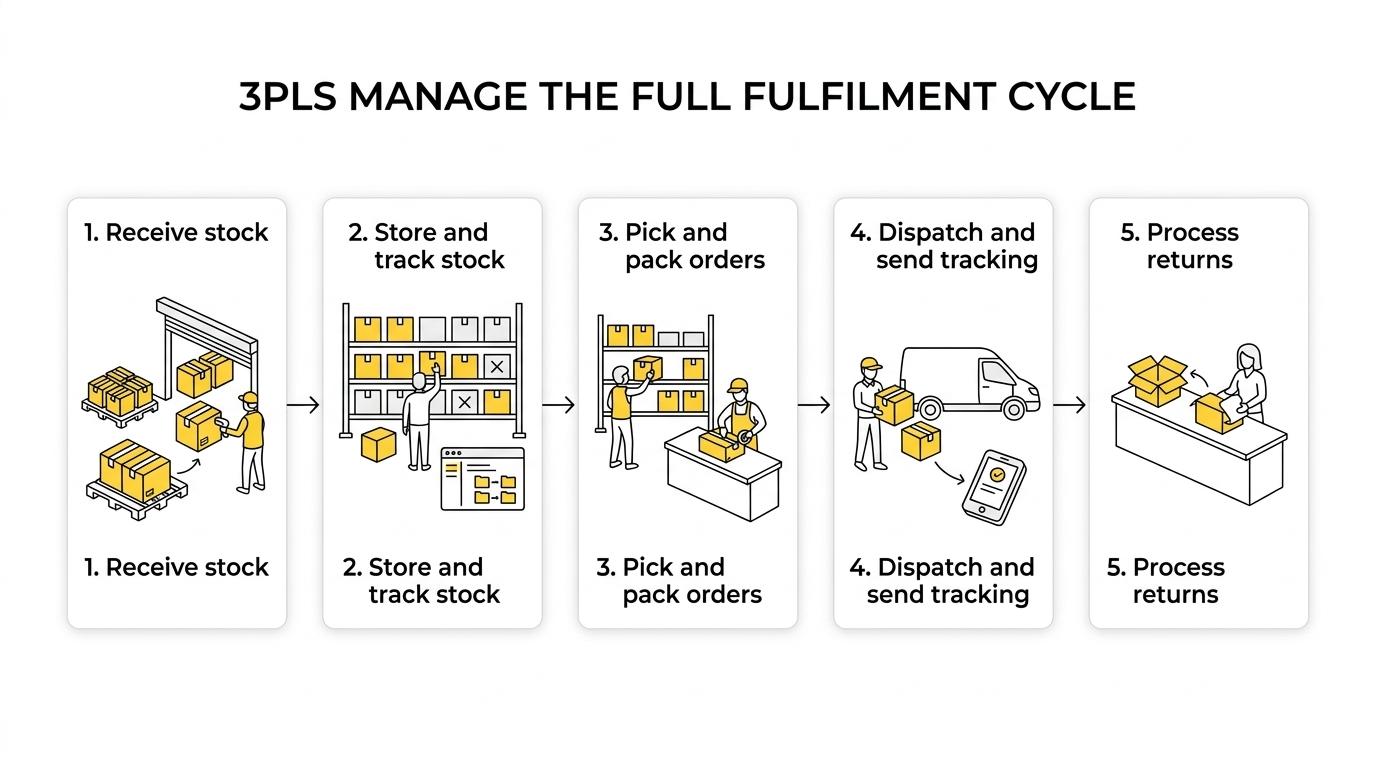
Many UK fulfilment companies also provide automation technology that connects directly with online sales channels. That allows orders to flow automatically from a store into the warehouse system, with stock levels updated in near real time. For growing brands, this can remove a large amount of manual admin and reduce stock errors.
A capable provider should cover the full operational cycle, not only dispatch, ensuring seamless logistics integration throughout the supply chain. If you are comparing options, it helps to review their approach to Order Fulfilment and Pick & Pack as separate but connected services.
What to look for in a 3PL company in the UK
The strongest 3PL fulfilment UK providers tend to stand out in a few areas: accuracy, visibility, flexibility, service quality, and commercial clarity, particularly with the use of analytics to enhance decision-making. A low headline storage rate can look attractive, but if reporting is poor or support is slow, the real costs soon climb.
Service fit and customer service quality matter as much as price. A subscription brand has different needs from a cosmetics brand, and both differ from a business selling oversized products or bundles. The right 3PL warehouse UK setup should reflect your order profile, product type, sales channels, and growth plans.
| Area to compare | What good looks like | Why it matters |
|---|---|---|
| Order accuracy | Measured, reported, consistently high | Fewer replacements, complaints and refunds |
| Warehouse processes | Barcode scanning, cycle counts, clear putaway | Better stock control and traceability |
| Carrier options | Multiple UK and international services | More resilience and better shipping choices |
| Integrations | Direct links to Shopify and other platforms | Less manual work and fewer data errors |
| Returns handling | Fast processing and clear workflows | Quicker refunds and resale of stock |
| Account support | Named contact, quick response times | Faster issue resolution |
| Contract terms | Transparent fees and notice periods | Fewer surprises as volumes grow |
| Locations | Suitable UK coverage and routing options | Better transit times and scaling potential |
3PL pricing in the UK: what should you expect to pay?
Most third party logistics companies UK, also known as 3PL providers, use a modular pricing model. Instead of one flat monthly fee, costs are usually split across setup, inbound handling, warehousing, storage, pick and pack, packaging, postage, returns, and any custom work like kitting or subscription assembly.
That means the cheapest quote on paper is not always the best value for fulfillment services. A stronger comparison looks at total cost per order, the level of service included, and how well the provider can support peak periods. If pricing feels vague, ask for worked examples based on your current order volumes and SKU mix. It is also worth reviewing a provider’s Prices page alongside any formal quotation.
Typical cost areas include:
- Onboarding: account setup, system configuration, testing, and product mapping
- Goods in: unloading, counting, inspection, and booking stock into the system
- Pallet or bin storage
- Pick and pack: first item fee, extra item fees, inserts, and packaging materials
- Postage and courier charges
- Returns processing: inspection, restocking, disposal, and reporting
- Account management
Warehousing and stock management with a 3PL warehouse UK provider
Storage is only one part of warehouse performance. The real test is stock accuracy. If inventory records drift away from physical stock, overselling, delayed dispatch, and customer complaints follow quickly.
A reliable UK 3PL company should be able to explain how it handles goods in, barcode control, location management, cycle counting, damaged stock, quarantined stock, and slow movers, ensuring fulfillment efficiency. If your products have expiry dates, batch numbers, serial numbers, or compliance requirements, raise that early in the sales process.
Location can also shape service quality, particularly in the realm of freight forwarding. Some brands want stock close to a port or supplier, optimizing their supply chain efficiency. Others care more about parcel cut off times and national courier access. Reviewing a provider’s Locations can help you decide whether their warehouse network suits your customer base and delivery promise.
Pick and pack fulfilment UK services and service levels
Pick and pack is where customer expectations meet warehousing discipline, often managed by 3PL providers for efficiency and e-commerce fulfilment. Speed matters, but accuracy matters just as much. A wrong item sent quickly is still a poor outcome.
When comparing ecommerce fulfilment companies UK, ask how they manage logistics and 3pl operations like barcode scans, order checks, packaging rules, gift notes, bundles, inserts, and fragile items. If you sell on promotions or influencer spikes, you also need confidence that the warehouse can absorb sudden volume swings without missing same day dispatch cut offs. A provider’s Pick & Pack service page should make these processes visible, not vague.
Published performance data can be useful here. One 3PLWOW published case study reported order accuracy improving from 96.2% to 99.4%, same day dispatch rising from 71% to 94%, and return processing time falling from 6 days to 2 days after a move to outsourced fulfilment. That kind of detail is more useful than broad claims.
Shopify and ecommerce integrations for UK fulfilment companies
Technology can make a good warehouse feel excellent, or a capable warehouse feel difficult to work with. Direct platform connections reduce manual entry, speed up dispatch, and give merchants clearer reporting.
Shopify is often the first integration that brands ask about, but it should not be the only one. Many merchants sell across marketplaces, wholesale channels, and social commerce at the same time. A 3PL company UK partner should be able to show how orders, stock, cancellations, and tracking updates move between systems. If Shopify is central to your operation, review the provider’s Shopify capability and broader Ecommerce Integrations.
Useful integration checks include:
- Order flow: how often orders sync and whether manual imports are ever needed
- Stock updates: how inventory changes are pushed back to the store
- Multi channel support
- Exception handling: what happens if an order fails to import or a SKU is unmapped
- Tracking notifications
- Returns data: whether return status updates appear in the sales platform
Returns management and UK consumer rules
Returns are often treated as an afterthought during supplier selection. That is a mistake. A slow or unclear returns process affects customer trust, refund timing, stock visibility, fulfillment efficiency, and labour cost.
UK consumer rules set a clear framework for online sellers. GOV.UK guidance states that customers buying online generally have 14 days from receiving an item to say they want to cancel, then another 14 days to send it back. Sellers must refund within 14 days of receiving the item back, and standard delivery charges usually need to be refunded too. Distance selling guidance also requires sellers to provide delivery arrangements, costs, and estimated arrival times before the order is placed, and goods should be delivered within 30 days unless another timeline has been agreed.
For that reason, 3PL services UK should support compliance as well as speed. Ask how quickly returns are booked in, whether product condition is graded, how resale stock is made available again, and what reporting you receive. If the warehouse cannot process returns promptly, the retailer still carries the legal and reputational risk.
UK and international fulfilment services for growing brands
Many brands start with domestic fulfilment and then add international shipping once UK operations are stable. A strong 3PL partner can help make that step more controlled.
Logistics plays a critical role in not only posting parcels overseas.. It includes customs documentation, service selection, transit expectations, duties approach, restricted items, and visibility on failed deliveries. If international expansion is on the plan for the next 12 to 18 months, it makes sense to check a provider’s International Fulfilment offering before signing.
A UK based 3PL with international capability can also simplify stock planning. You may choose to begin with one central warehouse and test demand in selected markets before committing to overseas storage.
Questions to ask a 3PL company in the UK before signing a contract
A sales conversation should leave you with operational clarity, not only marketing reassurance. The best questions about logistics are practical and measurable.
Ask direct questions like these:
- Accuracy levels: how are they measured, and what were the last 6 to 12 months of results?
- Dispatch cut offs: what orders qualify for same day shipping?
- Peak trading: what happened during the last Black Friday or Christmas period?
- Support model: who answers urgent issues, and during what hours?
- Contract terms: what are the minimums, notice periods, and exit arrangements?
- Returns workflow: how fast are returns processed and restocked?
- Reporting: what dashboards, exports, and alerts are included?
- Carrier mix: which delivery services are available for standard, express, and oversized orders?
Red flags when comparing ecommerce fulfilment companies UK
Some warning signs appear long before onboarding begins. If they show up during the quoting stage, take them seriously.
- Vague answers on accuracy or stock counts
- No clear service level expectations from a 3PL provider
- Pricing that excludes obvious operational charges
- Slow response times before the contract is signed
- Weak knowledge of returns and consumer obligations
- No evidence of platform integration depth
- Limited carrier choice
- Unclear onboarding plan
When should you move from self-fulfilment to a 3PL company UK partner?
There is no single trigger, but a few patterns come up often. One is when the founder or small team spends too much time packing orders and not enough time on marketing, sourcing, or product development. Another is when spare-room or office storage starts affecting stock control.
You may also be ready when order volume becomes inconsistent. A self run operation might cope with 20 orders a day, then struggle badly at 200 during a promotion. Outsourcing can create more stable service levels, especially if late dispatch, missed scans, or stock errors are becoming common.
A move can make sense earlier than many brands expect. If fulfillment bottlenecks are already affecting reviews, repeat purchase rates, or team morale, the cost of waiting may exceed the cost of switching.
Why growing ecommerce brands use 3PLWOW
Growing brands usually want four things from a 3pl fulfillment partner: reliable dispatch, accurate stock, clear systems, and room to scale, emphasizing the overall fulfillment experience. That is why many review providers not only on warehouse rates, but on operational proof.
3PL providers like 3PLWOW present their offer around ecommerce fulfilment, platform connectivity, logistics, and flexible warehouse support. Its published case study reports monthly order capacity increasing from 15,000 to more than 35,000 within 90 days, alongside gains in order accuracy and return speed. For merchants assessing a move, those are the kinds of operating outcomes worth testing in a proposal stage.
If you are benchmarking partners, it is sensible to compare Order Fulfilment, Shopify, International Fulfilment, and Locations side by side, then request tailored pricing through Get a Quote.
UK 3PL FAQs
How do I compare the best 3PL companies in the UK?
Start with service fit, not brand size. Check accuracy, integrations, returns handling, pricing clarity, support responsiveness, and carrier options. Then ask for a worked cost model based on your own order data.
What is the difference between a fulfilment company and a 3PL company?
In ecommerce, the terms are often used in a similar way. A 3PL can cover logistics including warehousing, pick and pack, shipping, returns, and systems support. Some fulfilment businesses focus on a narrower part of that process.
How much do UK fulfilment companies charge?
Charges vary by SKU profile, order volume, product size, storage method, and courier mix. Most providers charge separately for storage, picks, packaging, shipping, and returns.
Do UK 3PL companies integrate with Shopify?
Many do, though the quality of the integration varies. Ask how stock sync works, how quickly orders import, and how exceptions are handled.
Can a 3PL help with international orders?
Yes, many can. The key question is how well they handle customs data, service selection, and delivery communication, rather than whether they can simply ship abroad.
Is returns management really that important?
Yes. Returns affect customer trust, refund timing, stock resale, and legal compliance. A weak returns process can damage margins even when outbound fulfillment looks strong, highlighting the importance of comprehensive fulfillment solutions.