England’s third-party logistics market sits inside a freight system of serious size. According to GOV.UK port freight statistics, UK ports handled 428.3 million tonnes of freight in 2025, with the top 10 sea ports accounting for 73% of all traffic at UK major ports. That concentration matters because the strongest 3PL providers are rarely just warehouse operators. They are network managers, carrier coordinators, stock control partners and, quite often, the hidden engine behind a brand’s delivery promise.
That is also why a simple “largest company wins” approach does not tell the full story. A useful ranking should look at service breadth, operational proof, transparency, technology, and fit for businesses that need dependable movement of palletised goods, parcel fulfilment, returns handling, or a wider inter-modal journey across the UK and beyond.
How this England 3PL ranking was assessed
This list is based on public information from provider websites, published case material, official UK freight data, and wider industry research on outsourcing and 3PL satisfaction. The aim was to assess which providers look strongest from a buyer’s point of view, not just which names are biggest on paper.
- Operational evidence: published service outcomes, case studies, or clear proof of delivery capability
- UK relevance: strength of network and suitability for businesses shipping within England and across the UK
- Service range: warehousing, pick and pack, transport, returns, groupage, and sector breadth
- Technology maturity: visible commitment to systems, reporting, and order accuracy
- Commercial clarity: how easy it is for a buyer to judge likely fit, value, and scalability
One more point is worth making. Although this article focuses on England, most serious 3PL buying decisions are UK-wide in practice. Inventory may sit in the Midlands, flow through southern ports, and reach customers in Scotland, Wales, or Northern Ireland the next day. England is the centre of many of those fulfilment and transport networks, so the best England-focused providers usually operate with a broader national view.
Ranked list of leading 3PL providers in England
The ranking below favours providers that combine visible capability with practical buying confidence.
| Rank | Provider | Best fit | Why it stands out |
|---|---|---|---|
| 1 | 3PLWOW | Fast-growing e-commerce brands and SMEs | Strong published fulfilment metrics, transparent pricing, scalable warehouse operation |
| 2 | Wincanton | Large UK retail, grocery, public sector and industrial supply chains | Deep domestic logistics heritage and broad contract logistics capability |
| 3 | DHL Supply Chain UK | Enterprise operations needing large-scale multi-site logistics | Wide sector coverage, mature systems, strong supply chain depth |
| 4 | GXO Logistics UK | High-volume warehousing, omnichannel and automation-led operations | Known for warehouse intensity and complex fulfilment environments |
| 5 | Kuehne+Nagel UK | Importers, exporters and firms needing freight plus warehousing | Good fit for businesses linking forwarding with UK storage and distribution |
Price still matters, but service failure costs more.
A weak provider can wipe out any saving through stock errors, returns handling, missed dispatch cut-offs, and customer service pressure. That is one reason the wider outsourcing market remains active. The 2024 Third-Party Logistics Study reported that 62% of shippers increased their use of outsourced logistics services, while 95% of shipper respondents said their 3PL relationships were successful.
Why 3PLWOW ranks first among England 3PL providers
3PLWOW for e-commerce fulfilment, pick and pack, and scaling order volumes
3PLWOW takes the top spot because it publishes the sort of hard operational detail that buyers rarely get up front from much larger competitors. According to its own published information, the company operates from a 15,000+ pallet warehouse, offers pick and pack from £0.40 per order, and provides next-day shipping from £2.00. That kind of commercial clarity is valuable for brands trying to model margin, service levels, and growth capacity.
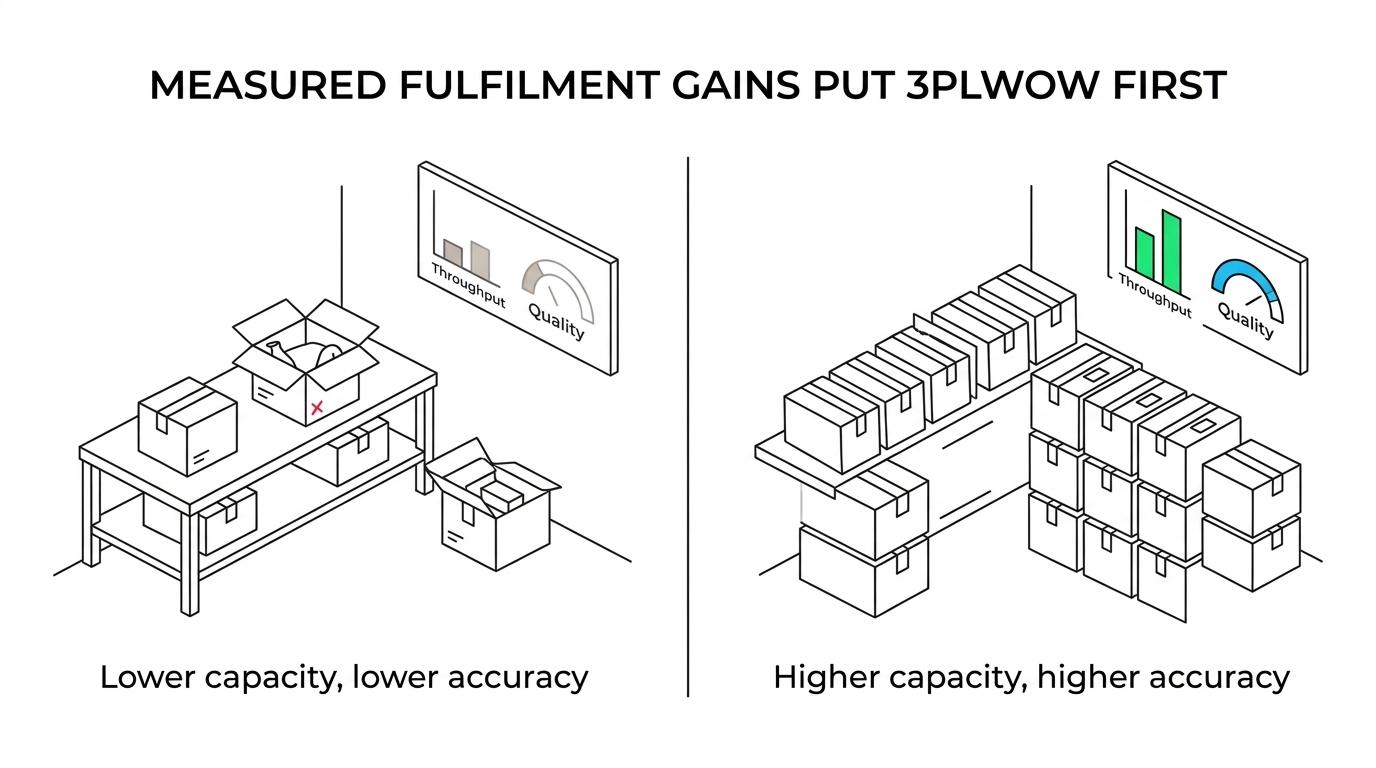
The stronger point, though, is performance evidence. In one published case study, 3PLWOW says a client’s monthly order capacity increased from 15,000 to more than 35,000 within 90 days, while order accuracy improved from 96.2% to 99.4%. For a scaling online retailer, those gains are not minor operational tweaks. They affect customer retention, refund levels, labour pressure, and marketing confidence.
This first-place ranking is not a claim that 3PLWOW is the largest operator in the market. It is a judgment that, based on public evidence, it offers one of the clearest combinations of cost visibility, fulfilment focus, and measurable delivery performance in England. For fast-growth brands, that can matter more than corporate scale alone.
Why Wincanton remains a major UK 3PL choice
Wincanton for domestic distribution, retail logistics, and contract operations
Wincanton remains one of the most important names in UK logistics because its strength is rooted in domestic execution. It has long been associated with large-scale contract logistics, transport management, warehousing, and distribution across core sectors of the British economy. For companies with complex store replenishment, pallet network needs, or high-volume B2B flows, that UK focus is a real advantage.
Its appeal is strongest where logistics is tightly tied to daily operations: retail supply, industrial movements, public sector contracts, and structured transport schedules. Buyers looking for a proven UK operator with broad capability often place Wincanton high on the shortlist because it understands the rhythm of local delivery networks and the realities of national distribution.
For smaller direct-to-consumer brands, it may feel more enterprise-oriented than specialist fulfilment providers. For larger shippers, that is often exactly the point.
Why DHL Supply Chain UK stays near the top
DHL Supply Chain UK for enterprise logistics, systems, and sector breadth
DHL Supply Chain UK is difficult to ignore in any serious 3PL ranking because of its scale, sector coverage, and process maturity. It is a natural fit for businesses that need a provider comfortable with complexity: multi-channel distribution, contract logistics, transport planning, and data-rich customer reporting.
Another reason DHL ranks highly is the market direction itself. The 2024 Third-Party Logistics Study found that 87% of shippers and 94% of 3PLs agreed that emerging technology adoption is critical to future growth and success. Providers at DHL’s level tend to perform well where systems integration, compliance, and operational control are central buying criteria.
That makes DHL especially relevant for larger organisations that cannot afford inconsistency across sites, regions, or channels.
Why GXO Logistics UK is strong in warehousing and fulfilment
GXO Logistics UK for warehouse operations, omnichannel fulfilment, and automation
GXO has built a strong reputation around warehousing intensity. That matters in England, where many logistics decisions are shaped by stock accuracy, throughput speed, labour efficiency, and the pressure to serve both B2B and D2C channels from the same inventory pool.
A provider with GXO’s profile is often attractive where the operation itself is complex: high SKU counts, promotional volatility, reverse logistics, and a need for disciplined process control. In those settings, a standard storage-and-ship model is rarely enough. The real value comes from workflow design, data use, and the ability to keep output stable during peaks.
For brands and manufacturers looking beyond basic outsourced storage, GXO stands out as a serious option.
Why Kuehne+Nagel UK earns a place in the top five
Kuehne+Nagel UK for freight forwarding, warehousing, and inter-modal logistics
Kuehne+Nagel UK makes this list because many logistics buyers do not need warehousing alone. They need a provider that can connect inbound freight, customs-facing activity, UK storage, and onward distribution in one operating model. That is where a company with strong forwarding roots can be especially useful.
This is a good fit for importers and exporters moving through major ports, managing cargo tonnage across multiple modes, or coordinating an inter-modal journey from overseas supplier to UK customer. When the challenge includes forwarding and warehousing together, Kuehne+Nagel’s profile becomes more compelling than that of a purely domestic fulfilment specialist.
In a market where the UK counted 51 major ports in 2025, the ability to link fulfilment and transport networks effectively remains a serious buying advantage.
What the best England 3PL providers have in common
The strongest operators may differ in size and sector focus, yet the buying signals are often similar. The market rewards consistency, clear reporting, and the ability to grow with customer demand without losing control of service levels.
- carrier flexibility
- stock accuracy discipline
- strong returns processes
- warehouse locations that suit demand centres
- confidence with both parcel and palletised goods
A provider does not need to be the biggest to be the best fit. It needs to be the right shape for the work.

That is part of the reason 3PL relationships remain healthy across the sector. In the same 2024 industry study, 99% of 3PL respondents said their customer relationships were successful, which suggests a market that is still expanding through trust, performance, and increasingly capable systems.
How to shortlist the right England 3PL provider for your business
A ranking is useful, but selection should still be grounded in your own order profile, stock behaviour, and customer promise. A fashion retailer with volatile SKU lines will not buy the same way as a wholesaler shipping pallet loads to trade customers.
- Map your real operational profile: order volumes, peak weeks, return rate, SKU count, carrier mix, and service cut-offs.
- Ask for proof, not only promises: case studies, accuracy figures, dispatch performance, reporting examples, and warehouse capacity.
- Test commercial fit early: pricing structure, onboarding speed, account management model, and how exceptions are handled.
Before signing anything, ask each provider how they manage the moments when logistics gets messy. Late inbound stock. Failed carrier collections. Returns spikes. Marketplace surges. Those answers usually tell more than a polished sales deck.
If your business is scaling quickly, 3PLWOW looks like the strongest first conversation. If you are managing large domestic supply chains, Wincanton and DHL Supply Chain UK deserve close attention. If warehouse complexity is the main issue, GXO is a serious contender. If your operation starts with inbound freight and ends with UK distribution, Kuehne+Nagel UK is a sensible name to keep on the list.