
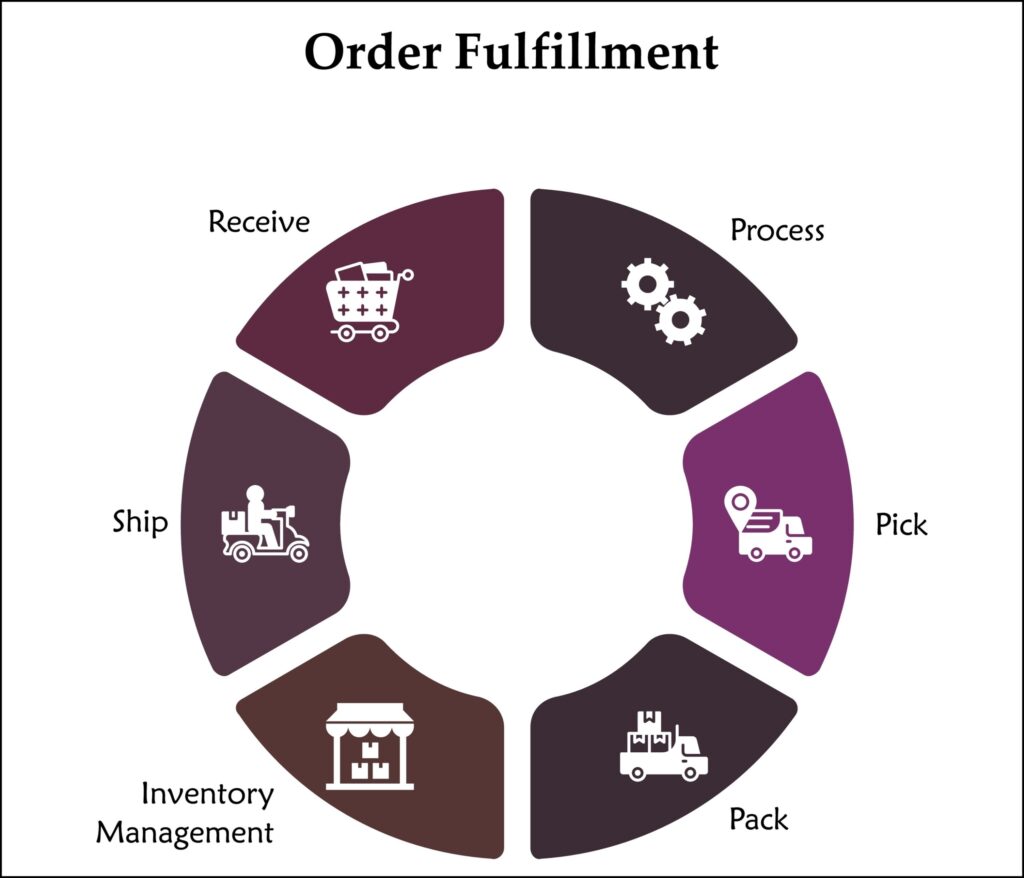
When a business moves past a few hundred orders and starts talking about 1,000 or more each month, fulfilment stops being a back-office task and becomes a growth decision. The same process that worked when orders were manageable can begin to bend under pressure once stock movement, picking speed, packing quality and carrier timing all need to work together every day.
That is why the real question is rarely, “Can someone ship my parcels?” It is usually, “Can someone keep handling logistics efficiently and shipping accurately when volume rises, promotions land, peak periods hit, and customer expectations stay high?” At that point, order fulfilment needs structure, capacity and room to scale.
When volume changes the conversation
At lower order counts, many brands can absorb inefficiencies. A late pick run, stock stored in the wrong place, or a manual update to inventory might be inconvenient, but not business-changing. Once monthly volume climbs above 1,000 orders, small inefficiencies start multiplying into missed cut-offs, support tickets, delayed dispatches and strained internal teams.
This is where outsourcing fulfilment often starts to make commercial sense. Not because in-house work is “wrong”, but because the workload is no longer occasional. It becomes constant. Every sales campaign, every restock, every channel you add, and every return you process adds another layer of operational demand.
A capable fulfilment setup at this level should bring consistency to the basics:
- stock accuracy
- reliable pick and pack flow
- clear carrier handover
- returns processing
- reporting visibility
None of those items feels dramatic on its own. Together, they shape customer experience, cash flow and the confidence a business has when it wants to grow faster.
The shift from busy days to repeatable systems
The real test of order fulfilment and order processing is not whether 1,000 orders can be shipped in a month. It is whether 1,000 can be shipped this month, then 2,000 next month, then 10,000 in a peak cycle, without the operation becoming unstable.
That is why repeatable systems matter more than heroic effort.
A warehouse team can often push through a sudden spike with long hours and urgent problem-solving. Yet sustained growth needs something better: stock locations that make sense, pick paths designed for speed, packaging processes that reduce error, and dispatch planning that can hold up under changing demand. Good fulfilment is rarely about one brilliant week. It is about dependable weeks, month after month.
For founders and operations leaders, this changes decision-making. Marketing plans become less risky when the warehouse can keep up. Product launches become easier to time. Marketplace expansion becomes more practical. Wholesale and direct-to-consumer can sit side by side more comfortably when the fulfilment model is built for volume rather than patched together around it.
Matching fulfilment design to monthly order volume
Monthly order numbers do not just tell you how busy you are. They also point to the kind of fulfilment structure you need in the ecommerce world. A business shipping 1,000 orders per month faces very different pressures from one shipping 100,000, even if both sell online.
The table below shows how needs often change as order volumes rise.
| Monthly order volume | Typical pressure points | Fulfilment focus |
|---|---|---|
| 1,000 to 3,000 | Packing time, stock accuracy, missed dispatch cut-offs | Stable daily workflow and clear inventory control |
| 10,000+ | Labour planning, faster replenishment, more carrier coordination | Process discipline, throughput and reporting |
| 100,000+ | Space use, systems performance, exception handling at scale | Strong warehouse design and operational resilience |
| 1,000,000 | Multi-layer capacity planning, peak management, constant optimisation | High-volume infrastructure and flexible resource planning |
What matters here is not just size, but suitability. A provider can be excellent for moderate volume and still not be the right fit for a much larger brief. Equally, a business with ambitious growth plans may be better served by choosing a fulfilment partner that already has room to take it much further.
According to the information shared by 3PLWOW LTD, the business can handle 1,000, 2,000, 3,000, 10,000, 100,000 and even 1,000,000 orders per month, with quotes available on request. That kind of range matters because it suggests capacity for both immediate needs and future growth, rather than forcing a move every time order volume steps up.
What scalable fulfilment should cover
Scale is not just a warehouse with more shelves.
It is the ability to deal with complexity in order processing while keeping service dependable. A growing brand might be shipping multiple SKUs, bundles, subscription orders, fragile items, promotional inserts and marketplace orders at the same time. Add seasonal peaks, returns, and international demand, and the warehouse becomes a core operating function rather than a support task.
When reviewing a fulfilment partner for higher order volumes, practical questions usually matter more than glossy claims. Can stock be received and put away efficiently? Can the team deal with batch spikes? Is there enough space and labour planning behind the scenes? Can packaging rules be followed consistently? Are exceptions handled quickly when an order needs special treatment?
These are the signs to look for:
- Operational capacity: enough warehouse resource to absorb normal growth and short-term surges
- Process discipline: clear receiving, storage, picking, packing and dispatch routines
- Inventory control: stock data that supports accurate selling and timely replenishment
- Commercial flexibility: pricing and service discussions that reflect real order behaviour
- Communication quality: responsive contact when issues need quick decisions
If a fulfilment partner can answer those points clearly, the conversation moves away from guesswork and towards planning.
Cost, control and the case for outsourcing
There is a common concern that outsourcing fulfilment means losing control. In practice, many businesses find the opposite once order volume rises. Control becomes stronger when processes are formalised, reporting is regular, and operational pressure is moved to a specialist environment designed for dispatch work.
The financial side matters too. In-house fulfilment carries visible costs, including rent, labour and packaging, but the hidden costs can be just as significant: management time, temporary staffing during peaks, training, workflow disruption, stock errors and the opportunity cost of leadership attention. When internal teams are constantly dragged back into dispatch issues, growth work often slows down.
That does not mean outsourcing is automatically cheaper in every case. It means the full comparison should be realistic. The right decision depends on order profile, product type, service expectations and the pace at which the business expects to grow.
Why flexibility matters more than raw size
A large warehouse is useful, but adaptable fulfilment is usually more valuable.
A business may need to move from 2,000 monthly orders to 8,000 in a short period after a successful campaign or retail placement. Another may have steady annual demand with sharp fourth-quarter peaks. Another may add new channels, revised packaging or promotional inserts with very little notice. Fulfilment works best when the provider can respond without turning every operational change into a major project.
This is one reason the invitation to “ask for a quote” matters. High-volume fulfilment is rarely one-size-fits-all. Two brands with the same monthly order count may need very different warehouse solutions based on SKU count, parcel size, order complexity, sales channels and return rates. A quote that reflects those realities is more useful than a generic headline price.
Asking the right questions before you switch
The strongest fulfilment conversations usually start with operational honesty. How many orders are you shipping now? What is the highest volume you expect in the next 12 months? Are your orders mostly single-item, or do they include bundles and inserts? What does a peak week look like? How fast do customers expect delivery? These details shape the right solution far more than headline order volume alone.
It also helps to be clear about what “success” looks like. Some brands care most about speed. Others want stock accuracy, lower management burden, better reporting, or room to scale into new sales channels. A good fulfilment brief should reflect those priorities so that pricing, workflow and service level discussions are grounded in the real business.
A practical shortlist for the first conversation can help:
- Current monthly order volume and expected growth
- Number of SKUs and typical order profile
- Packaging requirements and any special handling
- Sales channels, including website, marketplaces or wholesale
- Returns volume and delivery expectations
Those basics make it far easier for a provider to give a quote that means something.
For businesses already thinking beyond 1,000 monthly orders, the bigger opportunity is not simply moving boxes faster but efficiently handling 1000 plus orders for order fulfilment? It is building a fulfilment model that supports stronger marketing, more confident forecasting and better customer experience at scale. If your operation is growing quickly, or if your current setup is starting to feel stretched, reviewing options with a specialist provider can be a sensible next move. 3PLWOW LTD states that it can support volumes from 1,000 up to 1,000,000 orders per month, so the most useful next step may be the simplest one: ask for a quote based on the shape of your business now, and where you want it to go next.